Glimmers: Hope Amidst the OCD Noise

GLIMMERS text over a silhouette of a person looking at the Milky Way galaxy.

When you have OCD your brain can feel so loud you think it’ll never be quiet again.  We catastrophise the world, always thinking worst case scenario, our brains are living in survival mode, unable to fully relax.

Anyone suffering from OCD will know how distressing and difficult it can be and at times our brains can feel like very dark places to inhabit. 

When I had my nervous breakdown back in 2021 my nervous system felt so dysregulated that the noise was unbelievably loud and constant!  Waking up was noisy, all day it was noisy and going to sleep was near impossible.    

At times I would sit outside in the garden, feeling pretty numb and watch the birds – mini glimmers I now realise.  I would find awe and beauty in watching them and they helped me remember that life is beautiful.     

What is a glimmer?

A Glimmer is a small, daily moment that sparks joy, safety, awe or gratitude.  It acts as the opposite of an OCD trigger.

I love the word ‘glimmers’ as it speaks to something magical and when you experience them they do feel magical. 

When everything is incredibly loud a ‘glimmer’ can feel like a bright light, pushing its way through the intense darkness – similar to a star in the night sky, all the more beautiful because of the darkness surrounding it. 

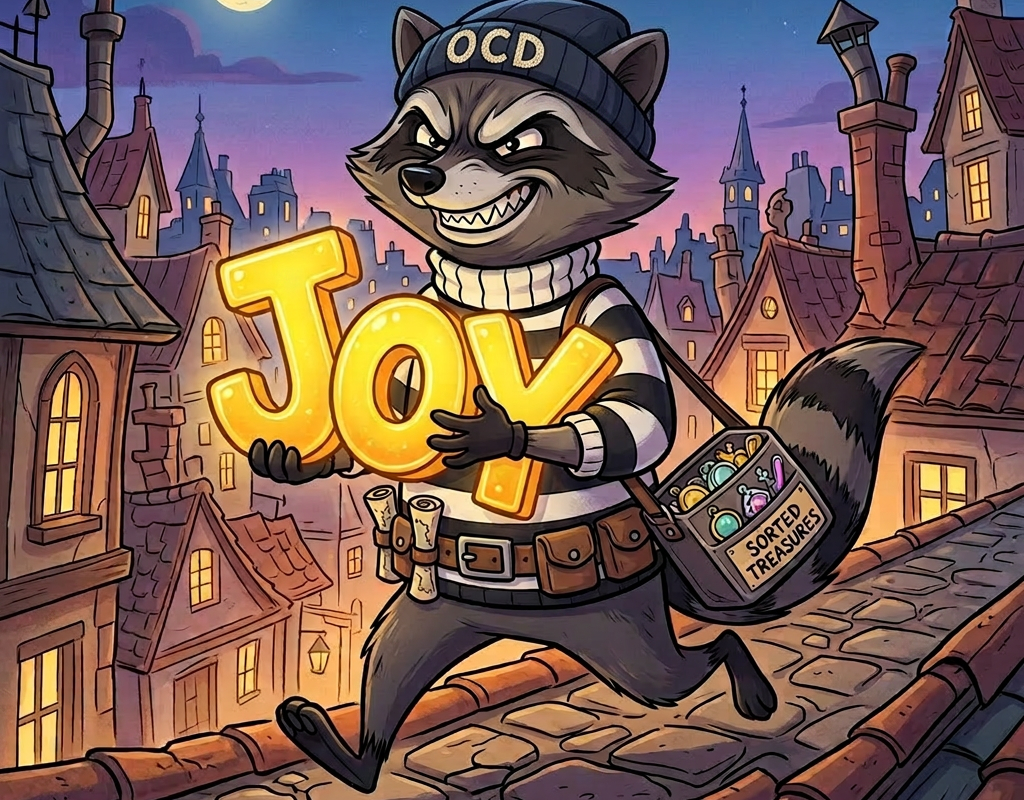
My OCD has taken a lot from me over the years but one thing it has given me is the ability to truly appreciate the small, beautiful things in life – which I believe most people miss.    

I can remember a time, not too long after my nervous breakdown, I’d come back from the school run and sat down on the sofa, I then had a moment of quiet.  It wasn’t long and I didn’t recognise the fact until after it had happened, but this little glimmer gave me hope.  It was enough to show me that it was possible for my brain to be quiet again.  This moment has stayed with me and was and still is highly significant to me in my recovery journey.

Can you think of any times when you’ve had a ‘glimmer’? They really are magical moments.

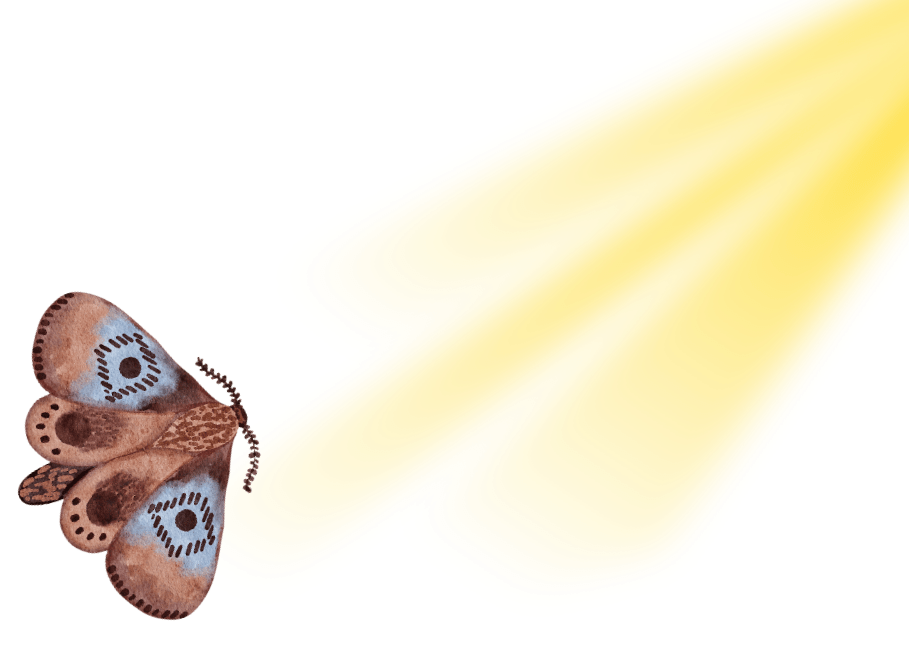
Remember to always look for the light in the darkness, like a moth to a flame, head for that light and hold onto it with all you have.

Remember you are not alone,  
As always, Stay Strong xxx   

Overcoming OCD: The Role of Expectancy Violation

In last weeks post I touched on the subject of expectancy violation and I thought it was such an important topic that it deserved its own post.   

What is Expectancy Violation I hear you ask?

It is a core mechanism in Exposure and Response Prevention (ERP) therapy, where a patient’s obsession is disproven by facing the fear (obsession) without doing the compulsion. By violating this expectation, the patient learns that their fear (obsession) is manageable, and their obsessive beliefs are false, which promotes long-term recovery. 

ERP therapy is all about proving to your brain that your OCD obsessions are unfounded and based on dodgy data.  We can only prove this to our brains by sitting with the obsession when it comes in and not partaking in the compulsion. 

Sounds easy right?  Well last weeks post was all about how the brain can make, ‘just sitting with it’, feel like a life or death situation and no I’m not exaggerating, anyone suffering from OCD knows this first hand.

The brain believes what it sees and it’s only action or sometimes inaction that can rewire the ‘faulty OCD circuitry’, currently running.    

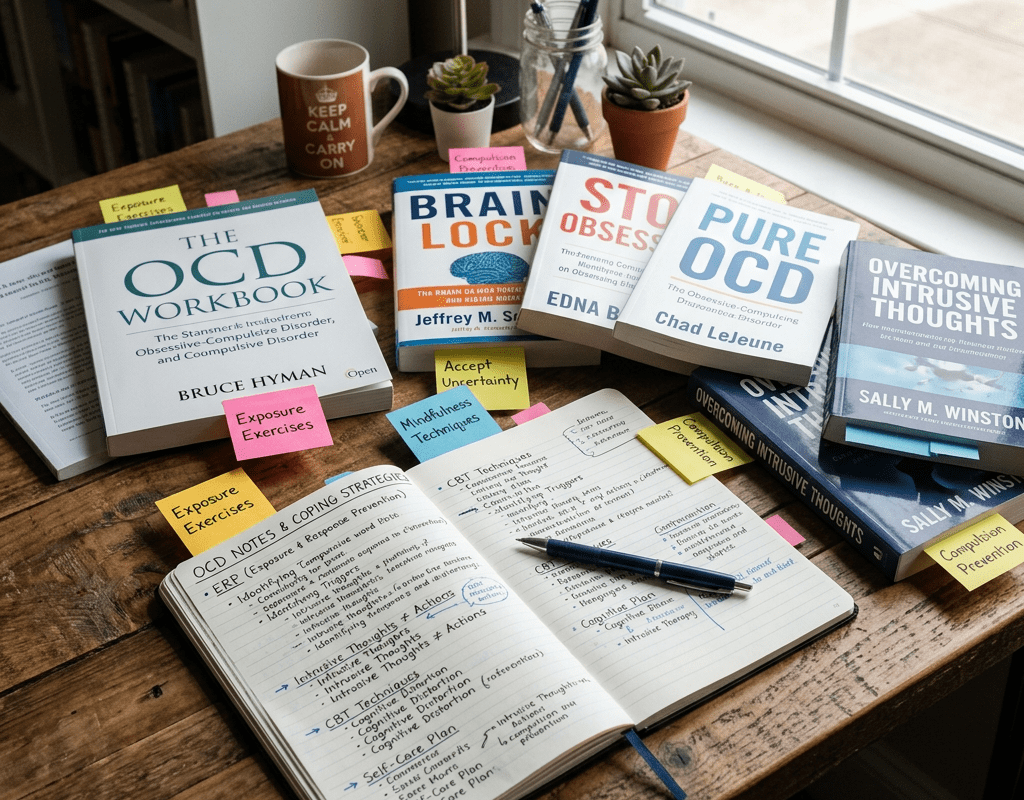
I realise ‘taking action’ can be hard and sometimes it can feel useful to sit and consume podcasts, books, blog posts and reels on OCD instead. This can make us feel like we’re ‘doing the work’, and don’t get me wrong I do truly believe psychoeducation plays a large part in OCD recovery but the real work is done out there in the real world, when you’re not making your life smaller to avoid triggers.

It’s only when you take part in your exposures, reframe from doing the compulsion and see that the ‘expected’ outcome doesn’t actually happen, that you receive this unbelievably important input – the expectancy violation – which then starts to rewire your brain with better more accurate data.

You have to remember to keep on pushing outwards so OCD can’t push you inwards. In my experience if you don’t continue to push yourself out of your comfort zone regularly then the ‘weeds’ (OCD obessions) start to sneak back in.

My advice therefore is to try and make ERP a lifestyle choice. When we accept our anxiety, knowing it’s a normal part of being human and carry on anyway we are winning against OCD. 

Are you still pushing out of your comfort zone each week? I’d love to know what you’ve been up to, let me know in the comments below so we can help inspire each other.

If you, like me, need a reminder now and again to keep on trying new challenges and exposures, then you might find one of my wellbeing journals useful. They have a weekly ‘Comfort Zone Cracker’, where you can set yourself small manageable targets to hit. It’s a fab companion for ERP therapy and life in general, they’re available from amazon and you can find the links to them here.

I really hope this post has been helpful,
As always, Stay Strong xxx

Understanding OCD as a Faulty Defence Mechanism

I’ve talked in a previous post about how OCD is closely linked to our sympathetic nervous system, how when we get triggered by an obsession, if we pay attention to it, we get thrown into fight or flight – which is not where we want to be. 

This system has it’s uses and, in the past would have been responsible for keeping us alive and safe but when we have OCD, this mechanism – which is designed to be a temporary state – can become a permanent trait! 

I guess this is because the brain has seen that by keeping us stuck in an OCD loop we are ‘safe’ from the ‘perceived threat’ and even though we can logically see it’s not a useful mechanism, all the brain can see – who’s main job it is to keep us safe – is that we are still alive, so job done. 

It’s worth noting here that the brains top priority is keeping us alive.  Not happy, not living our best life, not being socially connected or prosperous, nope, just being alive and if it thinks there are risks and threats out there that need to be avoided – due to OCD’s faulty system – and it thinks the OCD spiral keeps you safe, then it is going to have you looping down that rabbit hole forever! 

It does seem that in OCD there is a ‘fault’ in the switch that allows us to dismiss obsessions when they come in, the threat system, seems ‘hot-wired’ but why? 

I personally believe (and current evidence seems to confirm) that the ‘fault’ comes from some sort of highly driven sympathetic time or event in a person’s life.  This person will most likely have a predisposition (genetic vulnerability) towards OCD; however I also believe that we don’t have to know what that time or event was, sometimes it’s obvious – birth of a child, prolonged periods of feeling unsafe or stressed but other times it’s not and that’s OK.    

Putting these two ideas together:

1. That OCD is a fault in the threat detection system
2. The brains top priority is to keep us safe,

we can see how OCD can be seen by the brain as ‘a useful tool’. It becomes a learned habit – ‘if I spend my time focused on OCD thoughts, then I’m safe’. 

Is OCD therefore a defence mechanism – albeit a faulty and unhealthy one – to ‘avoid life and keep us safe’?

It feels like quite a big question and something that people with OCD might object to but just stop and think for a second. 

Does your OCD stop you from living the life you’d love to live?  And in doing so does your brain – rightly or wrongly so – believe that it is keeping you safe?

Another interesting insight I had was that with OCD we tend to know that the obsession is unfounded, and logically not true but because we can’t be 100% sure we get stuck. 

Is this another, particularly clever, part of the mechanism?  We sit at home ruminating and so not venturing out into the ‘scary world’ with the ‘unpredictable uncertainty’ – but it’s never enough to ever fully convince us that the obsession is true. Therefore, we stay at home, where we are stuck but according to the brain safe, job done. 

It’s an uncomfortable theory right: is OCD a defence mechanism the brain uses to keep us safe? 

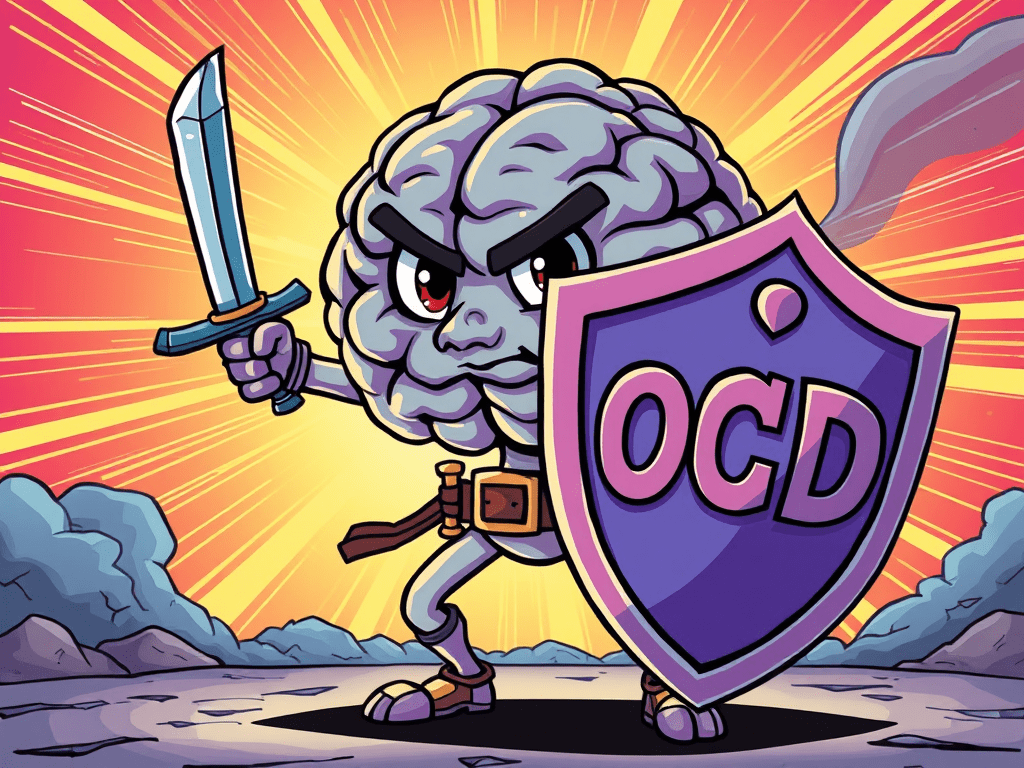
If we look at OCD this way, then we can start to see it for what it is – a badly calibrated, unhealthy and faulty protection system which for whatever reason can feel productive and useful – it’s not. 

We need to start to write a new story, remember the brain will always focus on the negative and try and find evidence to prove itself justified. 

I would bet for all the negative evidence it finds there’s just as much, if not more positive evidence to the contrary, your brain is just not seeing it – tunnel vision.  You need to widen the spotlight and make it a flood light. This way you can see the whole picture and realise everything OCD has been telling you is a very convincing LIE! 

This idea of OCD as a faulty safety mechanism has helped me to see that my brain is just trying to keep me safe, it has allowed me to be a lot kinder to myself and even laugh at the non-sensical nature of it. 

I hope it helps you too,  
As always stay strong xxx

The Power of Surrender in OCD Recovery

Surrender is something I’ve been trying to implement more in my life recently. 

I have written previously on how trust and confidence in the process of ERP are so important but also allowing yourself to surrender any internal resistance – which by the way can feel impossible at times – is really important, doing this allows your system time to discover it can cope and reset. 

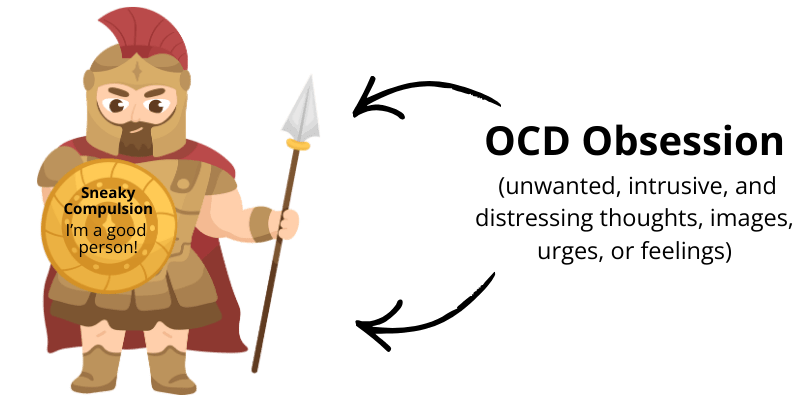
I’ve recently noticed a sneaky OCD compulsion I have, where when an OCD thought comes in I naturally start to make a list of all the reasons that thought is rubbish.  It’s not even a fully conscious thing I do, but I have noticed me going:

‘Well, there’s no way I’d do __________ because I’m a good person and I’ve never done anything like that before and actually this feeling of doubt is a sign that I’d never do ________ and why would you hurt someone you love?’ etc, etc, etc

Does this sound familiar?  I think for a long time I’ve done this thinking it helps, but I’ve now realised it’s a damn COMPULSION!  Which has been keeping me stuck, argh!!!!

So, surrender is now my new strategy, noticing when this inner monologue kicks in and letting go of the need to defend my character. 

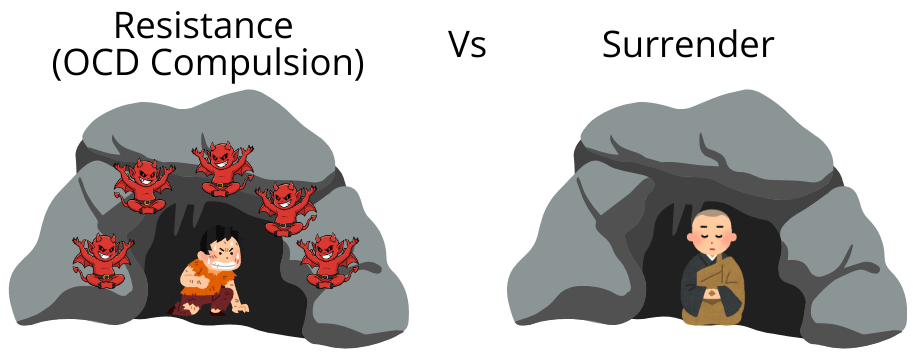
It reminds me of something I read called ‘Resisting the demons’ from Tara Brach’s book: ‘Trusting the Gold’, which I’d like to share.  It’s about a twelfth-century Tibetan master, called Milarepa and it goes as follows:

‘…he returned one evening to find his cave filled with demons.  Although he understood that they were just projections of his own mind, that didn’t make them any less threatening or horrible.  But how was he to get rid of them?

First, he thought teaching them spiritual truths might help.  They just ignored him. Angry and frustrated he ran at them, trying to push them out of the cave.  Far stronger than he, they laughed at him.  At last, Milarepa gave up, sat down on the floor and said, “I’m not leaving, and it looks like you are not either, so let us just live here together.”  That’s how we might finally respond to the especially stubborn demons we live with: “Well, that’s just the way I am.  I guess I have to live with it.  This is just the way life is.” 

But to Milarepa’s surprise, when he stopped resisting, instead of taking over, all the demons got up and left the cave.  All except one, and this one was particularly powerful. Milarepa realised that the only thing he could do was have the courage to deepen his surrender.  He walked over to that great demon and placed his head inside it’s gigantic mouth. “Just eat me up if you want to,” Milarepa said.  At that moment the demon vanished.’ 

Does this story resonate with you too?

I can see how the demons represent OCD obsessions, the ‘teaching them spiritual truths’ is a compulsion and feels a lot like what I’ve been doing recently with my, ‘I’m a good person reasoning’.

It does feel that surrendering – counterintuitive as it seems – is the only way to allow the thoughts to come and go without the distress. It’s only when we stop, judging, controlling, tensing against and avoiding our compulsions that we arrive in a more open, tender and healing space where the thoughts lose their power over us. 

I think it can feel ‘useful’ to be fighting against and battling our inner ‘demons’ at times but years of struggle has taught me that it’s not. 

When you finally stop it can feel a bit open and spacious, which is uncomfortable in a different way, the brain likes to be busy and it’ll want to fill that space with something. It is a creature of habit, so you will probably still get the doubt feeling coming, even if you’ve let go of the obsession, you need to get used to that feeling. If you don’t the brain will try desperately to attach it to another obsession – this is known as the ‘whack a mole’ effect – but know if you let it be the brain will eventually realise it doesn’t need to produce that feeling any more.

OCD recovery can feel like a long road but stick with it because the peace and clarity you get in the good times is worth it.

As always, you are not alone,
Stay Strong xxx

Understanding OCD Through Relational Framework Theory

Does this sound familiar?

You’re out enjoying your day, you feel happy, in fact you feel really good and then all of a sudden out of no where you get hit with an OCD obsession.  ‘Ugh you think, why now when I was having so much fun and feeling so happy?’    

Why indeed?

Well there’s a theory to why this happens and it’s called, ‘relational framework theory’ in fact it’s what ACT – acceptance commitment therapy – is built upon.

I’m sure I’m not going to be as good as the creators at explaining how it works so please go look up Steven C. Hayes if you have a chance but the theory is based upon the concept that humans think relationally. 

This basically means that humans can and do relate objects in their environment to other objects. Virtually in any possible way e.g. same as, better than, opposite of, greater than, faster than, part of, similar to or like, before and after, if/then, family relationships, near and far etc,
There are all sorts of ways in which we sort and link information in our minds and it has been amazing for our evolutionary progress however it also opens us up to the possibility of immense suffering.   

Lets dig a little deeper

As we grow as humans, we create vast networks of relationships in our brains.  We link objects together so we are better able to make sense of them and recall them when needed. 

Ever found that when learning something new if you can relate it to or build upon something you already know it’s far easier to remember?  Or when you try and recall someone’s name it can help to remember where you know them from? 

This is because your brain has linked ‘Julie from the gym’, with the gym in your head, therefore remembering the gym will help you recall Julie’s name. 

Julie from the gym might also have other connections such as she has a daughter who goes to the same school you used to attend or maybe she likes to play netball and so does your friend Jane – Jane and Julie will now be linked in your mental framework too.

Here’s a little game you can play to help demonstrate this further:

Write down one noun – any type of object or animal will do

Noun 1 _________________________

Now write down a second noun

Noun 2________________

Now answer the following 3 questions:

  1. How is the first noun related to the second one?
  2. How is the first noun better than the second one?
  3. How is the first one the parent of the second one? 

The third one can take a bit longer but given a bit of time an answer will come.

This exercise highlights how the brain can relate anything to anything else!!!!!!!  It is an interesting insight as ultimately not everything can be the parent of everything; however, the brain justifies these relations by features it abstracts from the related facts. Your mind can always find a justification for that relation!  Sound similar to OCD?

Bringing us back then to OCD and the start of this post.

We can see how obsessions (unwanted, intrusive, and distressing thoughts, images, urges, or feelings that repeatedly enter a person’s mind and cause significant anxiety.) can become linked to events, people, places, circumstances, actions, words, smells, music/sounds etc.

The obsession, whatever it is, can become attached to an existing relational framework in our brain, triggering our OCD every time we then come into contact with that object or framework in the future!

‘ARGH!!!!!!!!!’

Does this sound familiar? 

Can you think of any frameworks that OCD has latched onto?  Maybe something in your bedtime routine, perhaps when you cook a meal and get the knives out, maybe when left on your own with your kids, perhaps when the news comes on, or it could be when you get into your car, the things OCD can attach itself onto are literally endless.

And unfortunately, once it has attached itself, as far as I’m aware, there’s no easy way to unattach it again.

Having an awareness of this is so important for OCD recovery because we have to accept that we are going to get triggered, and if we fight it, push it away or try and block it out, it just makes it stronger and even more sticky.  You can’t unravel these networks they are too vast and convoluted.    

So what can we do?

We have to let go of the struggle.

There’s a lovely ACT metaphor which illustrates this nicely

Someone is standing in a battlefield fighting a war. The war is not going well.  The person fights harder and harder.  Losing is a devasting option, but unless the war is won the person fighting it thinks that living a worthwhile life will be impossible. So the war goes on. 
Unknown to this person however is that at any time they can quit the battlefield and begin to live life now.  The war may still go on and the battlefield may still be visible. The terrain may look very much as it did while the fighting was happening but the outcome of the war is no longer very important and the seemingly logical sequence, of having to win the war before beginning to really live has been abandoned. – Extract Taken from: Get out of your mind and into your life by Steven C. Hayes. 

Here we see that the way to move forward is to stop fighting, accept the obsession and carry on with our lives aligning to our values.  Eventually the brain sees the link to the framework as unimportant and stops bringing your attention to it so readily, however every now and then it will throw it back up to check if its important and it’s your job at this point to say:

‘thank you brain that’s exactly what I wanted to hear right now’

and then carry on with your day aligning to your values – for more information on values work check out my post here.


If you’re enjoying learning more about ACT therapy then I would highly recommend looking up Steven C. Hayes, which is who a lot of these ideas have come from. 

A small thank you at the end of this one for your ongoing support, this is my 100th blog post and definitely something which should be celebrated.

As always, Stay Strong xxx

ACT Metaphors for OCD Recovery

I’ve written a lot recently about how when we have OCD, if we give into our compulsions we are likely to be plunged into our sympathetic (fight or flight) nervous system.   

This is an issue as when in this state we are unable to think rationally and our intrusive thoughts can feel all overwhelming. 

There are some great ACT metaphors which we can use to illustrate this concept, below are 3 of my favourites, let me know which one’s yours:

1. The fog

When an OCD thought comes in imagine it like fog being blown towards you.  You have the choice, at this stage, to not participate, let the thought be and wait for the fog to dissipate or you can give into the compulsion.  Every time you give into the compulsion, whatever it may be, imagine a new layer of fog being blown towards you, further damping your ability to see clearly.

2.Ripples on a pond

Here the OCD obsession is like a stone being thrown into a pond.  If we do nothing and let it be the ripples will soon disperse and we will be able to see clearly again. If however we give into the compulsion it’s the equivalent of throwing a new stone in every time.

3.The bus stop

Here we see that before we are triggered we are standing at the bus stop watching the traffic go by.  If we then get triggered and give into the compulsion it is the equivalent of walking out into the road and being surrounded by the traffic, therefore not being able to see clearly.

There are plenty more of these metaphors out there, if you’ve found these ones helpful why not have a look around for some others or if you know of another helpful one then add it in the comments below, I’d love to hear it. 

I do think the metaphors can make it all seem very easy to just draw yourself back out of fight or flight. I don’t for a second want to belittle how hard this is to do when you’re in it, believe me I know, but it can help to show what the effect of giving into an OCD compulsion can be and hopefully it gives you another tool and incentive to not give into those compulsions when they come along, they really do only lead to misery. 

I really hope it helps, as always remember you are not alone.
Stay Strong xxx 

OCD: Your thoughts are NOT special! 

A small idea with a big impact which I’d like to share with you today is a statement I heard on a podcast:

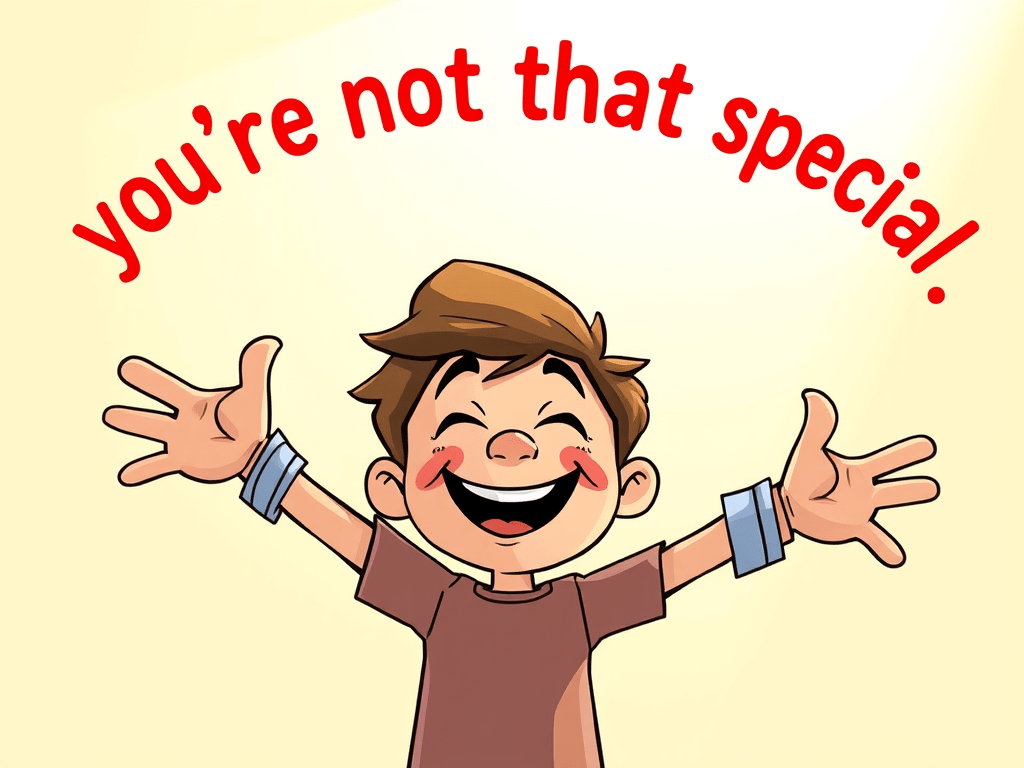
‘You’re not special’

It sounds kind of simple and maybe a bit mean but as humans we generally like to think of ourselves as being unique and different from everyone else. 

The reality of thinking in this way however is that it can make us feel that our problems/issues/intrusive thoughts are unique too.

This is an issue, if we think our problems are unique then we can believe them to be unsolvable.

When we have OCD we think, ‘no one else will have had these thoughts before’, this can lead to us becoming isolated and withdrawn.

The reality however is that we’re not that special and the more likely scenario is that multiple people will have experienced the same thoughts you have. 

Our brains like to keep us isolated and trapped believing it keeps us safe, but I’m here to tell you:

THIS IS RUBBISH!!

A side note here to say when it comes to OCD I would go to a OCD therapist, rather than a friend, as they will have the training to help you understand what is going on and see the thoughts for what they are – faulty signals being sent from your overactive amygdala. 

A short one today but such a powerful idea, which always helps me when I think of it. 

I really hope it helps,
Remember you are not alone and you’re not that special either! 
Stay Strong xxx

Conquering OCD: Recognizing Fight or Flight Responses

In my last post I talked about the threat bucket metaphor and how it relates to our resilience levels – if you haven’t read that one you might want to go and check it out first – link to pervious post.

In this post we’re going to look closer at why it’s particularly bad for your bucket to overflow when you have OCD and why your self-care is of the upmost importance. 

Why it’s so bad for OCD when your bucket overflows?

When we have OCD we want to do everything we can to keep our resilience as high as possible, why? 
Well, when in fight-or-flight, our brain shifts into ‘survival mode’ this, like OCD, changes how you think, not just how you feel.

Our goals switch to speed and safety over accuracy, nuance and long-term reasoning – not what we want when dealing with OCD intrusive thoughts. 

Here’s a summary of what’s happening in the brain when our resilience drops (bucket overflows).

1. Our brain’s “thinking centre” goes offline – The prefrontal cortex (responsible for reasoning, planning, empathy, and impulse control) becomes less active.

This means:

  • We have a reduced ability to think logically
  • Difficulty seeing multiple perspectives
  • Poor working memory (“I can’t think straight”)
  • And more impulsive reactions

You’re not choosing this—blood flow and neural activity are redirected away from this area.

2. Our threat-detection system takes over – our amygdala and related limbic structures start to dominate.

This means our thinking becomes:

  • Threat-focused (“What’s wrong?”)
  • Binary (safe vs dangerous, right vs wrong, black vs white)
  • Fast and reactive
  • Emotion-driven

Our brains are asking one question only: “How do I survive this?”

3. Cognitive narrowing occurs, Fight-or-flight (an overflowing bucket) causes tunnel thinking.

You may experience:

  • Fixation on one detail or outcome
  • Loss of creativity and flexibility
  • Difficulty accessing learned skills – this is why prepping in advance for triggering situations is so important
  • Overgeneralization (“This always happens”)

This is efficient for survival—but limiting for problem-solving and not where you want to be when experiencing intrusive thoughts.

4. Biases increase – in survival mode, the brain relies on shortcuts, common thinking patterns include:

  • Catastrophizing
  • Mind reading (“They’re against me”)
  • Personalization
  • Black-and-white thinking

These are not “bad habits”—they’re stress (OCD)-induced neural shortcuts.

Understanding all this helps you realise that you can’t reason or ruminate your way out of fight-or-flight (OCD)—you regulate your nervous system first. Thinking comes back after ‘safety’ is restored.

BUT…
…how do we know if we’re in fight or flight in the first place?
and
…how do we get out of it and stay out of it when our amygdala keeps letting off faulty signals all the time?
I hear you ask.

Honestly it can feel impossible at times, I get it! 

First things first, the best way I’ve found to work out if I’m in fight or flight is from Martha Beck:

Ask yourself:
‘Am I suffering/struggling?’

If the answer is, ‘yes’ then you can almost guarantee you’re in fight or flight.   
There’ll be no logic involved, you won’t be thinking rationally – you need to stop.    

Our bodies are designed to move between rest and digest and fight or flight naturally and if you can recognise you’re dysregulated and sit with the uncomfortable feeling then great, do that.

I have however found some nice ways to speed up the process, so you can start to see things more rationally more quickly!   

Here are some of the best tools I’ve found to come out of fight or flight when in it:

  1. Creativity – this will mean different things for different people but creativity is amazing at switching on a different part of the brain, drawing your attention away from the catastrophizing part. Quite often if you can focus on creating something, whether it be a piece of art, a yoga sequence, something in the kitchen, garden, workshop, on the computer, anything that gets you thinking outside the box, you will start to draw your attention back to a more balance place.
    What’s your creative outlet?
  2. Curiosity – This can be curiosity about anything, quite often when we become curious and interested in something it grounds us and pulls us away from that extreme black and white thinking. Try asking why? Maybe investigate how something works or why it’s the way it is.
    Have you ever wondered about anything?
  3. Humour – is fabulous for getting the brain to switch modes. It works because its unexpected, remember the brain is a prediction machine and it’s pretty good at it. When a joke comes along and it doesn’t end where the brain think it will, BAM! You’re out of default mode and the brain is switched on and listening.
    Do you like any particular comedians? Go and look up one of their new sets online.
  4. Awe – part of the joy of being human is our ability to find awe. It can really give you some perspective when you look at the stars, birds, clouds, landscape etc. Going out into the world and finding things that make you think, wow! Is very important to our wellbeing and it helps us reset.
    What brings you that feeling of awe?
  5. A Challenge – this can be tricky when you’re in fight or flight but something which I found fun – from Martha Becks book – was to try and write your signature backwards. It takes a huge amount of focus and is very grounding. Go on, give it a try!
  6. Foundations Work – movement, nutrition, sleep, relaxation & social connection.  This takes an element of doing what you know is good for you, even when you don’t feel like it. We have to take action first, do the things we know make us feel better in the long run, your body and brain will thank you.

I really hope some of these methods are useful for you, give them a go and see what works.  It can be very individual which is tricky but once you’ve found the thing that works it can be seriously life changing.  Once back in rest and digest quite often we can let the thought go and see it as completely irrational, but if not, at this stage we can work through Byron Katies, questions.

Ask yourself:
Is it true?
Is it 100% true?  If the answer is no – which it always is in the case of OCD as it is based in doubt and uncertainty – then:

YOU HAVE TO LET IT GO!!!!!!

As I said in one of my previous posts, why would you torture yourself over anything less than 100% certainty?

I really hope this post has helped you to understand the role the nervous system plays in OCD and why it’s so important to recognise when you’re in fight or flight and find useful ways to bring yourself back. Only when out of fight or flight can we rationalise, think clearly and see OCD thoughts for what they are, just thoughts.

And if you ever wanted a reason not to complete a compulsion in the first place then remember, every time you give into one of those unwanted, intrusive, and distressing thoughts, images, urges, or feelings you’re filling up your bucket a little bit more and getting closer and closer to fight or flight, where it all starts to fall apart! 

Leave that thought be and carry on with your life aligning to your values. 

I really hope this post helps, education and knowledge are so vital for OCD recovery,
As Always, you are not alone,

Stay Strong xxx  

Understanding Thought-Action Fusion in OCD

Thought-action-fusion is a common cognitive distortion associated with OCD.  It’s where a person believes that having a thought is equivalent to performing an action, or that thinking something makes it more likely to happen.

It is a very important distortion to be aware of if you’re suffering from OCD as when you’re in fight or flight mode – talked about in my previous post – anything can feel possible.     

Remember when we are suffering from OCD we are highly likely to be in the fight or flight (sympathetic) part of our nervous system. When in fight or flight our ability to think rationally goes out of the window and so things that we know to be impossible, when in our rational minds, can feel possible! 

When struggling and ruminating on an OCD obsession the brain and body are suffering with high stress (fight or flight), when in this state our memory becomes selective and fragmentedOur attention narrows (tunnel vision) and our hippocampus (memory organiser) works less efficiently.

The result of this is that we can get gaps in our memory, Out-of-order recall and confusion about timelines. In addition to this the brain searches for danger-related memories, and the Safe or neutral memories are harder to access. 

It’s important to note that a Strong memory ≠ accurate memory.  Stress increases confidence in memory and emotional intensity but decreases, detail accuracy, context and perspective! 

All this results in intrusive memories feeling more real because they’re emotionally tagged

  • “What if” thoughts feel urgent due to amygdala activation
  • Memory distrust develops (“What if I forgot something important?”)

This fuels checking, reassurance, and rumination.

For me this was one of the most enlightening distortions to learn about.  Following my nervous breakdown, I was constantly in my sympathetic nervous system and so I had a few events when an intrusive thought occurred, and I couldn’t remember clearly/rationalise it/work it out, this caused me unbelievable distress. 

Thought-action-fusion can make you feel like a thought is real and because of your mental state your inability to rationalise that distortion feeds the uncertainty.  We need to recognise this pattern when it happens for what it is and reduce the impact by:

  • Not trying to ‘figure it out’ while anxious – this includes during the night, no analysis between 11pm and 5am remember! 
  • Remembering that you’re in fight-or-flight, you’ll be thinking in extremes and this is not evidence.
  • Find ways to reset and come back into the parasympathetic nervous system (rest and digest). 

I really love Byron Katies method for this where we say:
Is it true?
Is it 100% true? 

If the answer to the second question is no – which it will be because the stress is based on doubt and uncertainty, then ‘you have to let it go’.   

Why would you torture yourself over anything less than 100% certainty? 

Fear lives in the vague after all and it’s my guess, it’s just a thought (obsession), attached to a feeling of uncertainty, that you’re basing your rumination on, not facts. 

Your brain is probably desperately trying to work out whether there is something genuine to be concerned about, you should take this as your sign that there isn’t!   

I really hope this helps, OCD recovery isn’t easy and sometimes thought-action-fusion can get worse when we are in recovery and start to let our guard down, but know and trust who you are and as always,

Stay Strong xxx

Expect and Accept: Overcoming OCD Thoughts

‘Expect and accept’, is a new mantra I’ve been trying out recently. 

I’ve found It can be helpful when managing OCD thoughts day-to-day to have a mantra to act as a ‘switch’ for the brain, helping you to label the thoughts as OCD and move on. 

Obviously in an ideal world you wouldn’t need it but it can be so easy at times to get dragged into OCD thoughts and before you know it, you’re freefalling down a rumination rabbit hole and all sense of reality has gone.

Don’t be fooled by the cute bunny, he may appear to be your friend but believe me he isn’t!

At times like this it can be so helpful to have a little reminder, like a therapist in your ear, saying to you:

So let’s be clear here, by saying ‘expect it’, I’m not saying, lets invite those thoughts along or will them to be there.  It’s more about having an awareness that if you’re going into a triggering situation, a new environment or out of your comfort zone, then it’s highly likely that your OCD will want to come along for the ride. 

I’ve found at times that I can get frustrated with my OCD when it turns up and what I’ve learnt over the years is if you don’t want it to be there, then it’s almost guaranteed to be.

When it does, if it does, we need to accept it.  We can do this by saying, ‘Thank you, brain that’s exactly what I wanted to hear right now’.

After all OCD recovery is not about getting rid of the intrusive thoughts, this is a common mistake, remember everyone gets them. So it’s more about allowing them to be there and then carrying on with your day regardless, aligning with your values. 

I realise how hard this is, but know that you are not alone and that every time you carry on with your day, despite the thoughts, you are making progress and the brain is learning it doesn’t need to freak out at every thought that comes into your mind.  

Why not give the mantra a go this week and see if it helps you too. Let me know how you get on in the comments below.

Remember: ‘Expect it and Accept it’

As always,
Stay Strong xxx