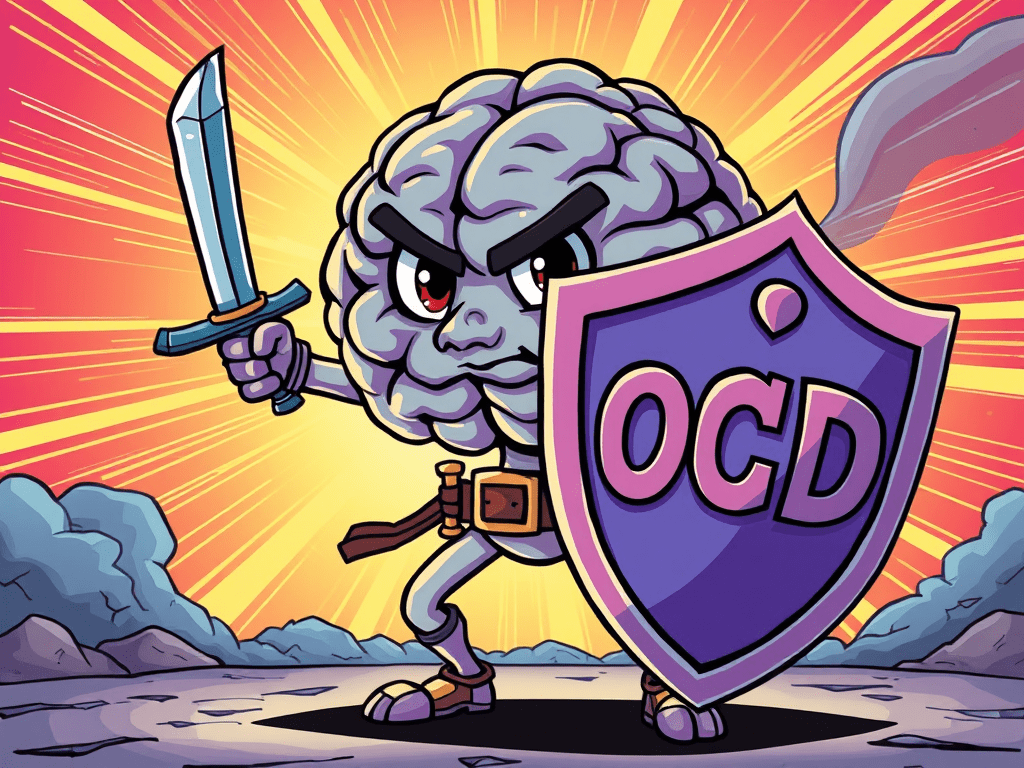
OCD: a WARNING system NOT a WANTING system!

Man standing next to multiple industrial safety and warning signs in a warehouse

This is something I’ve been playing with this week and I’ve found it really helpful so I thought I’d share. 

Putting together a couple of ideas from previous posts:

1. When we have OCD the amygdala – whose primary function is to process emotions, especially fear and anxiety – is sending us a faulty signal that there is something which needs our attention right away and cannot wait.
and
2. OCD is ego-dystonic, meaning: against the self or being inconsistent with one’s true beliefs, values and personality.

It follows then that if we are getting pretty constant ‘faulty’ alerts from our amygdala’s and we know that these alerts are against our values, beliefs and personality, that we shouldn’t take much notice of them.

We need to see these alerts as a warning system – which is what it is and not a wanting system, which it couldn’t be further from being.

Our brain is basically saying; ‘Careful you wouldn’t want that to happen!’ or ‘If that happened wouldn’t it be awful?’ and all we have to do is say, ‘Yes! That would be awful, thanks for looking out for me brain.’

By acknowledging the thought and thanking the brain, we also help defuse ourselves from it (an idea used in ACT therapy), this logical process helps keep our thinking brain online. 

If we give the thoughts (obsessions) any time, we switch on our sympathetic nervous system (fight or flight), where our thinking brain starts to switch off and then there’s no logic or reason available to us – not where we want to be.

In Summary
Know you are getting the thoughts as the brain is WARNING you of wrongly perceived danger and not because you are wanting or inviting the thoughts. 

Simple but effective, hope it helps,
As always, Stay Strong xxx

OCD: Why You Feel Exhausted All The Time

Man sitting on bed with head bowed, hands clasped, in soft morning light

One thing that isn’t spoken about much in OCD and its recovery is just how exhausting it is. 

We’re told that we should, ‘carry on with our lives despite the OCD thoughts’ – which continue to pop in by the way – always sitting with, rather than avoiding our obsessions and generally making ERP a lifestyle choice! 

And whilst this is great advice which I agree with, it’s easy to forget that, when we’re consistently pushing outside of our comfort zones and taking part in exposures, it’s incredibly tiring for our nervous system. 

I’ve recently been training for a Sprint triathlon.  I signed up for this event in part because I’ve always been a bit anxious about swimming and I thought it would help push me through this anxiety and improve my confidence in the water. 
All good in theory but in practice, it has been exhausting.  I get into the pool, put my head under the water and my brain gets extremely loud. 
My swim teacher is amazing with lots of incredible tips and advice but if I listened to my brain, after that first swimming lesson, I would never have gotten back in the water.  The following day I was completely exhausted from how dysregulated my nervous system had been, and this is just one example. 

Therapists make ERP (Exposure Response Prevention) sound so simple and down on paper it is:

  1. Write a list of exposures,
  2. Tackle them one at a time,
  3. Sit with the associated anxiety without completing any compulsions. 
  4. The nervous system will reset on its own – as it’s designed to do.

The reality I’ve found however is that the nervous system does not reset easily, and it can feel easy to beat ourselves up about this.  In fact, what you have to do is treat your nervous system like a scared puppy which needs a hug.

Golden retriever puppy sitting on a rug looking upward indoors

I noticed the other day, when sitting with an uncomfortable thought, that I was holding unbelievable tension in my body, once I noticed and relaxed this tension the thought eased.
I wondered after whether, without recognising that I was holding tension and consciously letting it go would my brain of relaxed? Did it need the sign from my body to say, ‘hey, it’s OK’.

Remember the brain is in a black hole and relies on inputs from the body and senses to know whether its safe.  

I’ve also noticed recently that when out and about I quite often hold my arms across my body.  I’m pretty sure this is a protection mechanism from my nervous system and a way my body holds onto OCD created tension subconsciously. 

Do you notice yourself holding tension in your body when triggered? 

I get to wondering; is held tension a subconscious compulsion or the nervous systems reaction to me being dysregulated by my OCD obsessions? Or are both of these the same thing? 

If we can treat obsessions by letting them be – which should eventually release tension in the body, can we also treat obsessions by sending messages from the body through grounding techniques, muscle relaxation and breathwork to the brain? Maybe a bit of reach? But think, if our body appears relaxed, is the brain more likely to relax too and as a result produce positive thoughts rather than catastrophic ones?     

This is after all how breathwork works, it sends a contradictory message to the brain as an input through the vagus nerve telling the brain ‘there’s no need to panic’ and it can relax. Its also what I did the other day when by releasing tension in the body the brain eased too. 

There is a huge amount of research being done at the moment about how the gut and brain communicate and how most of the messages actually go from the gut up to the brain (80%). If our nervous system is sending copious messages up to the brain at all times, then surly a two pronged approach to OCD recovery: sitting with the thoughts (ERP) but also using body relaxation techniques – when not used in a compulsive way – should be beneficial for OCD recovery? 

Heading back to exhaustion for a moment – as a result of nervous system dysregulation through ERP exposures. Here we see a snowball effect as when we feel tried, we reach for the sugar and caffeine to keep us going, these can further dysregulate our nervous system, sleep and ability to relax.  Our internal environment then becomes even more challenging for our nervous system to reset and as a result the OCD obsessions can become more sticky.

Why not take a moment now and pause, see where your mind is at and whether you’re doing anything subconsciously to make the state of your mind worse than it needs to be. Are your shoulders tense, are you making a fist with your hand, do you push your nails into your palms or are you constantly on high alert? These are just a few examples but there are lots of ways the body reacts and holds tension when it doesn’t feel safe and regulated.  

Let me know your thoughts on using the body to calm the mind and if you’ve found it useful. I believe it has a place in OCD recovery as if we can’t relax our bodies our minds will never be still.

I really hope it helps,
As always, Stay Strong xxx

But how do I know if it’s OCD?

Ocean waves forcefully crashing against a rocky outcrop in blue water

Ever heard your OCD brain saying:

‘How do I know if it’s OCD, this time it feels so real!’

This is one of OCD’s biggest hooks and it will throw it at you every single time

Each time you get triggered, for whatever reason, it will feel urgent and like it must be looked at right now!  In fact, if it does feel urgent you should use this as your first clue that it is your OCD at play.

A question I like to ask myself at these times is:

‘Am I struggling?’

If the answer to this question is yes, then use this as your second clue that OCD is playing its nasty game with you.   

One of the reasons we generally fall down the ‘ruminations rabbit hole’ is that we’re not 100% sure whether it’s our OCD, or whether this time the trigger is something to be genuinely worried about. 

But I can guarantee that if you’re struggling with the thought then you’ll be starting to spiral and if you’re spiralling you’ll be heading into your sympathetic (fight or flight) nervous system. 

When in this part of the nervous system we don’t think rationally, as the prefrontal cortex – our thinking brain – starts to go offline and our more primal survival brain starts to take over. 

This is not where we want to be when dealing with OCD thoughts as we don’t think rationally, it’s all about extremes and as a result we end up thinking what OCD is telling us is ‘reasonable’ somehow! 

Honestly the things my brains convinced me are possible when in fight or flight is madness and yet somehow, when in that dysregulated state, it seems perfectly reasonable. 

Here are some examples which might sound familiar:

  • That bump in the road was probably a human which I completely missed.
  • Even though I’ve already washed my hands they’re not clean.
  • What if I push that person into the road as I walk past them?
  • Maybe that red spot is blood, what if I pick up an infection from it?

In fact right now, as I’m writing these down, my brain is saying: ‘What if by writing these things down it makes them more likely to happen? ‘

I mean you get the idea, all the above are situations where OCD has taken 1 + 1 and come up with 20.  It has made huge leaps, completely by-passing any sort of logic, reason or fact and because you are in your sympathetic nervous system, it makes them seem possible! 

In summary,

  1. If it feels urgent
    or
  2. You’re struggling

know that it’s your OCD at play and you need to take a step back, definitely don’t engage!!!

It seems too simple but if you can keep these two ideas in your head when you get triggered then it will empower you to sit with the uncertainty. They also go a long way to helping you identify the thought as OCD and this is a well-known defusion exercise (from ACT therapy) which helps switch the thinking brain back on.

I know it’s unbelievably hard to sit with the uncertainty but know that completing any type of compulsion does nothing apart from validate the OCD trigger, highlights it as important to the brain and sends you off into your sympathetic nervous system (fight or flight) where all logic switches off.

Do your best to not engage with any OCD compulsions, OCD may appear to be your ‘helpful friend’ but it most defiantly isn’t.  Given the chance OCD will steel everything from you, it feels no empathy and will take you to hell if you let it!

I really hope these tips help you as much as they have me,
As always, Stay Strong xxx

Understanding OCD as a Faulty Defence Mechanism

I’ve talked in a previous post about how OCD is closely linked to our sympathetic nervous system, how when we get triggered by an obsession, if we pay attention to it, we get thrown into fight or flight – which is not where we want to be. 

This system has it’s uses and, in the past would have been responsible for keeping us alive and safe but when we have OCD, this mechanism – which is designed to be a temporary state – can become a permanent trait! 

I guess this is because the brain has seen that by keeping us stuck in an OCD loop we are ‘safe’ from the ‘perceived threat’ and even though we can logically see it’s not a useful mechanism, all the brain can see – who’s main job it is to keep us safe – is that we are still alive, so job done. 

It’s worth noting here that the brains top priority is keeping us alive.  Not happy, not living our best life, not being socially connected or prosperous, nope, just being alive and if it thinks there are risks and threats out there that need to be avoided – due to OCD’s faulty system – and it thinks the OCD spiral keeps you safe, then it is going to have you looping down that rabbit hole forever! 

It does seem that in OCD there is a ‘fault’ in the switch that allows us to dismiss obsessions when they come in, the threat system, seems ‘hot-wired’ but why? 

I personally believe (and current evidence seems to confirm) that the ‘fault’ comes from some sort of highly driven sympathetic time or event in a person’s life.  This person will most likely have a predisposition (genetic vulnerability) towards OCD; however I also believe that we don’t have to know what that time or event was, sometimes it’s obvious – birth of a child, prolonged periods of feeling unsafe or stressed but other times it’s not and that’s OK.    

Putting these two ideas together:

1. That OCD is a fault in the threat detection system
2. The brains top priority is to keep us safe,

we can see how OCD can be seen by the brain as ‘a useful tool’. It becomes a learned habit – ‘if I spend my time focused on OCD thoughts, then I’m safe’. 

Is OCD therefore a defence mechanism – albeit a faulty and unhealthy one – to ‘avoid life and keep us safe’?

It feels like quite a big question and something that people with OCD might object to but just stop and think for a second. 

Does your OCD stop you from living the life you’d love to live?  And in doing so does your brain – rightly or wrongly so – believe that it is keeping you safe?

Another interesting insight I had was that with OCD we tend to know that the obsession is unfounded, and logically not true but because we can’t be 100% sure we get stuck. 

Is this another, particularly clever, part of the mechanism?  We sit at home ruminating and so not venturing out into the ‘scary world’ with the ‘unpredictable uncertainty’ – but it’s never enough to ever fully convince us that the obsession is true. Therefore, we stay at home, where we are stuck but according to the brain safe, job done. 

It’s an uncomfortable theory right: is OCD a defence mechanism the brain uses to keep us safe? 

If we look at OCD this way, then we can start to see it for what it is – a badly calibrated, unhealthy and faulty protection system which for whatever reason can feel productive and useful – it’s not. 

We need to start to write a new story, remember the brain will always focus on the negative and try and find evidence to prove itself justified. 

I would bet for all the negative evidence it finds there’s just as much, if not more positive evidence to the contrary, your brain is just not seeing it – tunnel vision.  You need to widen the spotlight and make it a flood light. This way you can see the whole picture and realise everything OCD has been telling you is a very convincing LIE! 

This idea of OCD as a faulty safety mechanism has helped me to see that my brain is just trying to keep me safe, it has allowed me to be a lot kinder to myself and even laugh at the non-sensical nature of it. 

I hope it helps you too,  
As always stay strong xxx

Understanding OCD Through Relational Framework Theory

Does this sound familiar?

You’re out enjoying your day, you feel happy, in fact you feel really good and then all of a sudden out of no where you get hit with an OCD obsession.  ‘Ugh you think, why now when I was having so much fun and feeling so happy?’    

Why indeed?

Well there’s a theory to why this happens and it’s called, ‘relational framework theory’ in fact it’s what ACT – acceptance commitment therapy – is built upon.

I’m sure I’m not going to be as good as the creators at explaining how it works so please go look up Steven C. Hayes if you have a chance but the theory is based upon the concept that humans think relationally. 

This basically means that humans can and do relate objects in their environment to other objects. Virtually in any possible way e.g. same as, better than, opposite of, greater than, faster than, part of, similar to or like, before and after, if/then, family relationships, near and far etc,
There are all sorts of ways in which we sort and link information in our minds and it has been amazing for our evolutionary progress however it also opens us up to the possibility of immense suffering.   

Lets dig a little deeper

As we grow as humans, we create vast networks of relationships in our brains.  We link objects together so we are better able to make sense of them and recall them when needed. 

Ever found that when learning something new if you can relate it to or build upon something you already know it’s far easier to remember?  Or when you try and recall someone’s name it can help to remember where you know them from? 

This is because your brain has linked ‘Julie from the gym’, with the gym in your head, therefore remembering the gym will help you recall Julie’s name. 

Julie from the gym might also have other connections such as she has a daughter who goes to the same school you used to attend or maybe she likes to play netball and so does your friend Jane – Jane and Julie will now be linked in your mental framework too.

Here’s a little game you can play to help demonstrate this further:

Write down one noun – any type of object or animal will do

Noun 1 _________________________

Now write down a second noun

Noun 2________________

Now answer the following 3 questions:

  1. How is the first noun related to the second one?
  2. How is the first noun better than the second one?
  3. How is the first one the parent of the second one? 

The third one can take a bit longer but given a bit of time an answer will come.

This exercise highlights how the brain can relate anything to anything else!!!!!!!  It is an interesting insight as ultimately not everything can be the parent of everything; however, the brain justifies these relations by features it abstracts from the related facts. Your mind can always find a justification for that relation!  Sound similar to OCD?

Bringing us back then to OCD and the start of this post.

We can see how obsessions (unwanted, intrusive, and distressing thoughts, images, urges, or feelings that repeatedly enter a person’s mind and cause significant anxiety.) can become linked to events, people, places, circumstances, actions, words, smells, music/sounds etc.

The obsession, whatever it is, can become attached to an existing relational framework in our brain, triggering our OCD every time we then come into contact with that object or framework in the future!

‘ARGH!!!!!!!!!’

Does this sound familiar? 

Can you think of any frameworks that OCD has latched onto?  Maybe something in your bedtime routine, perhaps when you cook a meal and get the knives out, maybe when left on your own with your kids, perhaps when the news comes on, or it could be when you get into your car, the things OCD can attach itself onto are literally endless.

And unfortunately, once it has attached itself, as far as I’m aware, there’s no easy way to unattach it again.

Having an awareness of this is so important for OCD recovery because we have to accept that we are going to get triggered, and if we fight it, push it away or try and block it out, it just makes it stronger and even more sticky.  You can’t unravel these networks they are too vast and convoluted.    

So what can we do?

We have to let go of the struggle.

There’s a lovely ACT metaphor which illustrates this nicely

Someone is standing in a battlefield fighting a war. The war is not going well.  The person fights harder and harder.  Losing is a devasting option, but unless the war is won the person fighting it thinks that living a worthwhile life will be impossible. So the war goes on. 
Unknown to this person however is that at any time they can quit the battlefield and begin to live life now.  The war may still go on and the battlefield may still be visible. The terrain may look very much as it did while the fighting was happening but the outcome of the war is no longer very important and the seemingly logical sequence, of having to win the war before beginning to really live has been abandoned. – Extract Taken from: Get out of your mind and into your life by Steven C. Hayes. 

Here we see that the way to move forward is to stop fighting, accept the obsession and carry on with our lives aligning to our values.  Eventually the brain sees the link to the framework as unimportant and stops bringing your attention to it so readily, however every now and then it will throw it back up to check if its important and it’s your job at this point to say:

‘thank you brain that’s exactly what I wanted to hear right now’

and then carry on with your day aligning to your values – for more information on values work check out my post here.


If you’re enjoying learning more about ACT therapy then I would highly recommend looking up Steven C. Hayes, which is who a lot of these ideas have come from. 

A small thank you at the end of this one for your ongoing support, this is my 100th blog post and definitely something which should be celebrated.

As always, Stay Strong xxx

Two things you need to cultivate to succeed in OCD recovery.

Having had OCD for 30 years now I have a lot of experience with dealing with intrusive thoughts.  What are the two main things I’ve learnt you need to cultivate to succeed in OCD recovery?

Firstly, Trust in yourself & secondly, confidence in the process

First let’s take TRUST.  OCD after all is the doubt disorder and generally most of our distress comes from doubting ourselves and our ability to cope.  We must learn to trust ourselves completely and in the choices we make. 

This is by no means an easy task, OCD can make you feel like you don’t know yourself anymore, it can make you think up is down, left is right, and black is white. 
Over time you can lose complete confidence in yourself, asking others for their options and trusting what they think over your own.  A sad and possibly quite scary situation if you choose to trust the wrong person. Do you ask for reassurance a lot from a loved one?

So how do we learn to trust in ourselves? 

Firstly, work out your values – Examples of values include; honesty, kindness, loyalty, compassion, courage, creativity, responsibility, respectful, authenticity, and dependability. The list is endless and very personal. If you haven’t done this yet then take a few minutes now and work out who you want to present yourself to the world as.  Ask yourself, who do you want to show up as day to day? 

(Still not sure where to start with your values?  Then google ‘core values quiz’ and you’ll get multiple options to guide you.)

Quite often when we feel uncomfortable it’s because of something called cognitive dissonance; this is when our actions/thoughts don’t align with our values.  You can however think of that uncomfortable feeling as a good thing, it’s OCD misaligning with who you believe you are as a person.  It’s a sign that it’s OCD is playing its evil game and has nothing to do with who you are as a person. 

Secondly, work out your reason – when times get tough in OCD recovery – and they will – you’ll need to dig deep and the way to do this is to find your reason for recovery.  Write it down, know it inside out and when it’s hard think of that person, reason or version of yourself, which makes the effort it worth.

Thirdly, action – the brain believes what it sees, we must step forward no matter how hard it feels.  Some days it may feel impossible – I know I’ve been there – but the only way to build trust is to be your own advocate and align with your values. 

Moving onto confidence, confidence in ourselves but also in the ERP process. 

ERP (Exposure response prevention) therapy is hard, it involves working out what you’re scared of/avoiding and slowly allowing yourself to exposure yourself to it. It goes against everything your brain is telling you to do and feels horribly uncomfortable but until the brain sees that it can cope in the situation – whatever it may be – it will be scared and doubt (mistrust) your ability to cope.

The hardest part of this process is creating the trust and confidence.  If OCD has done it’s job well, you may be starting at zero on the trust scale.  How can you trust something with no evidence?  That’s what the brains telling you right?  Sure, the nice therapist is telling you it works but the brain only believes what it sees.

Somehow you have to step off the shore into the lake and realise its not as deep as you thought.  I admit it can feel like jumping out of an aeroplane with a parachute attached to your back not knowing if it’s been packed properly.  This is, I believe, why you either have to get to absolute rock bottom before you truly start on that road to recovery or your reason has to be bigger than you, to make the risk of jumping into the unknown worth it.

Of course, once you start on the process you start to build evidence quickly that it works, every time it’s easier to jump, so to speak, but it does take time and energy.  I love the analogy of OCD recovery being like a set of fairy lights.  It’s not all or nothing like a flashlight, it’s slow and gradual, they come on one at a time as the brain learns to trust in the process. 

We must make ERP a lifestyle choice, constantly building up that catalogue of evidence as proof to the brain that we are capable and can trust ourselves when the intrusive thoughts come along.  It is only once you have tried and see the desired outcome that your brain will learn that it can sit with the doubt & uncertainty. 

So, ask yourself, do you trust myself? 

I’d love to hear about some of the times you pushed outside of your comfort zones even though it was hard. If this resonates with you please share your experience below.

As always,
Stay Strong xxx 

OCD & Anxiety – The Intolerance of doubt and uncertainty

The intolerance of doubt and uncertainty is a big one when it comes to OCD and anxiety.  Ultimately, it’s what it all comes down to – not being able to sit with that uncomfortable feeling and trying to certainty – which is impossible by the way.  

As humans we hate not knowing, we love to fix, sort and order things, it keeps us calm and gives us a sense of control.  Unfortunately, life doesn’t really work that way – especially a life worth living – it is full of risk, uncertainty and not knowing what’s around the next corner. 

Why does uncertainty feel so horrible, well it’s all to do with that organ up there inside our skull, the brain.  It’s number one job is to keep us alive and if it’s knows what’s coming next it’s chances of that are much higher.  It loves predictability, set routines and absolutely no surprises, that way it can relax and keep you safe, job done.  

However, if we do the same things all day every day life can get a bit dull and limited. As humans, we like to try new things, the brains not always so keen though. Why? Well If we’re going to try new things then it’s going to have to do some work.  If we’re going to risk stepping outside of our comfort zone, then the brain needs to make sure we’re safe and making sensible decisions and so it’s going to start sending some signals our way. 

Say you want to go and try a new gym.  You used to love exercise and you’ve been really keen to get back to it since having your kids.  You haven’t been to the gym for a good few years now and there’s likely been some changes, which means there’s going to be things you’re uncertain about – cue the brain, tactic one – talk you out of it   

‘You’re not in as good a shape as you used to be, and you don’t know if you’ll be able to get through the class.  ‘  

‘There are lots of different classes on the timetable which you don’t recognise, what if you book onto the wrong one?’ 

‘You don’t know anyone there, what if no one talks to you?’ 

‘You won’t know your way round, what if you get lost on the way to a class and people think you’re stupid?’  

You get the idea, lots, and LOTS of uncertainty, things you don’t know about the place, other bits you’ll have to work out when you’re there and maybe you’ll feel a bit uncomfortable and embarrassed because everyone else knows what they’re doing and where they’re going.

Cue the brain again,

‘Are you sure you want to do all that?  Seems like a lot of effort.  Wouldn’t it be easier not to?  We could just stay at home like we normally do and chill on the sofa with the family.  We enjoy that and then we don’t have to go through any of those horrible feelings ‘

How would you react to this situation, does it sound familiar?  Are you good at talking yourself out of things? 

This is intolerance of uncertainty!!  The brain hates it, it will try and talk you out of it any way it can. 

However if you don’t listen and go anyway the brain steps it up a notch by throwing some nerves/apprehension/anxiety your way.  It’s worth saying at this point that this is very NORMAL, we should feel nervous when we go into new territory this is the brain telling you to ‘be careful/vigilant, there might be danger ahead’.

Trying new things, pushing outside of your comfort zone and attempting to grow as a person is ALWAYS going to feel uncomfortable.  The only way to show the brain that the situation is safe is to go through it.    

Let’s look at a couple of ways we can reframe the thoughts above:

Brain – ‘You’re not in as good a shape as you used to be, and you don’t know if you’ll be able to get through the class? ‘  

Try – ‘Everyone has to start somewhere and who cares if I make it to the end of the class, any exercise is better than no exercise – which is what I’m doing now – just getting there will be a great achievement.  It’s completely normal to feel a bit anxious in this situation. ‘  

Brain – ‘There are lots of different classes on the timetable which you don’t recognise, what if you book onto the wrong one?’ 

Try – ‘If I book the wrong class, I’ll give it a try and then I’ll know whether I’ll like it for next time, it’ll be fun to try something new and I might even find a class I love, thanks brain.  ‘ 

Brain – ‘You don’t know anyone there, what if no one talks to you?’ 

Try – ‘Why wouldn’t anyone talk to me, that’s pretty negative brain.  If I come in with a smile, I’m sure people will be pleasant but even if they aren’t I’ll be fine, I’m a big girl but thanks for checking in brain.’      

Brain – ‘You won’t know your way round, what if you get lost on the way to a class and people think you’re stupid?’  

Try – ‘If I get lost, I’ll ask someone the way and I’ll work it out, I always have in the past but thanks for taking care of me brain.’    

OCD feeds into this a lot to, whatever your theme may be, it most likely boils down to the fact that you’re not willing to sit with uncertainty in some way. 

Examples may include:

‘Maybe that red spot I touched was blood and now I have a horrible disease’.

‘Maybe I hit someone on the drive home from work’.

‘If I don’t do ______ 4 times _____ will happen’.

‘If I don’t double check the oven is off the house might burn down’.

‘If I don’t double check the front door is locked, we might get burgled’.

There are loads of these but ultimately OCD will just feed into the areas of your life where you are unable to sit with uncertainty and they will most likely be the things you love and care about the most.  It normally all comes down to a core belief that you won’t be able to cope if _________ happens. 

So we have to get better at sitting with that icky feeling and not just white knuckling our way through it either, you have to expect it to come and accept it’s presence WILLINGLY. 

Why not try out some of the following next time you’re in a situation where you’re feeling a bit anxious, and your brain starts throwing things your way.

‘I can see I feel a bit anxious, that’s completely normal in this situation, thanks for keeping me safe brain’.

‘That’s exactly the thought I want right now’.

‘I want this feeling because it means that I’m growing as a person and that’s exciting’. 

Then get straight back to whatever you’re working on. 

All this being said we do need to work with the brain and build it up slowly, if you are having panic attacks every time you get into a car following an accident, then perhaps you need to sit in the car with the door open on the drive a few times and show your brain all’s fine before going off and taking a 3 hour drive on the motorway.  Only you will know what’s tolerable to sit with and what’s not. 

Have a good think about how you can push into uncertainty and strengthen your ability to sit with those uncomfortable feelings. 

Good luck!  This is not easy work but keep those end goals in focus and they will give you the strength to get through those uncomfortable feelings and start taking back control of your life.

Stay Strong

Fiona Fox