Navigating OCD: Essential Tips During Tough Times

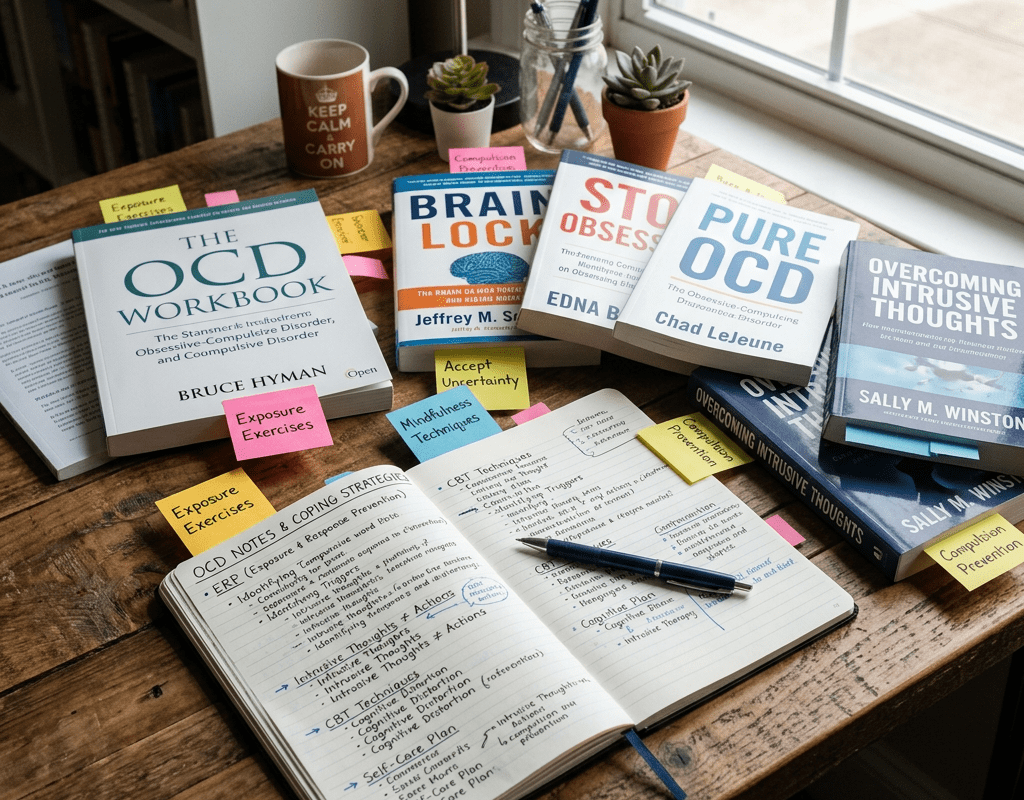
Books and notes about obsessive-compulsive disorder with highlighted coping strategies and sticky notes

Having had OCD for 30 years I’ve come to realise how important it is to have a few easily accessible resources and a plan of action in place for those times that, despite our best efforts, we end up spiralling.  

It’s very easy in the good times to forget how hard and dark it can be but when we are feeling good we should take a bit of time to get organised with what helps, just in case.

Let me try to explain in a bit more detail what I mean. 

In an ideal world we would learn how OCD works – a glitch in the good enough system – get really good at sitting with that uncomfortable feeling (doubt and uncertainty), let our nervous system do its thing and reset on its own back to base line and carry on with our day. 

And while this is all good in theory and doable a fair amount of the time, it is my experience that recovery isn’t a straight line and there will still be times when we get caught by an OCD obsession. 

Here are some examples of circumstances that can make OCD stickier;  Nighttime can be tricky, as well as when I’m particularly tired, if I’m already sitting with a trigger and then another one piles on top, time of the month for ladies, a new theme appears and takes you by surprise, or a difficult life circumstance such as illness, coping with loss, or stress to name a few. 

All of these will affect our resilience and ability to manage our OCD effectively; I’ve definitely noticed that the exact same thought can effect me differently depending on my resilience level.   

At these times, when we’re spiralling despite our best efforts to let things be, I’ve found it can be helpful to have a few resources to hand, they help remind me of OCD’s wicked and insidious ways and switch on the prefrontal cortex enough to pull me back. 

I personally have a notebook filled with all my favourite advice and information from a wealth of people and books I’ve read over the years.  Some of which I’ve shared below. 

As well as this I’ve finally started to populate my resources page, if you get a chance go and check it out and let me know what you think or if you know of any other useful resources I can add.  I will continue to update this page as time goes on.

I really hope it helps! 

Highlights from my notebook

A thought on Thought-Action-Fusion

Why would you torture yourself over anything less than 100% certainty?  Fear lives in the vague after all and it’s my guess, it’s just a thought (obsession), attached to a feeling of uncertainty, that you’re basing your rumination on, not facts. 
Your brain is probably desperately trying to work out whether there is something genuine to be concerned about, you should take this as your sign that there isn’t

A couple of quotes from Dr Stephen Phillipson

‘You can’t use feelings to make determinations based on whether a threat is real. Doing so is like asking the devil for directions to heaven’.

‘Why focus on something you have NO control over?’
‘It’s never going to not feel scary. ‘

An insight from Martha Beck

Ask yourself:  ‘Am I struggling?’  If the answer is ‘yes!’ then you’re spiralling, step away. 

Useful information from Prof. Steve Peters:

‘If you wake during the night, any thoughts or feelings you might have are from you chimp (emotional) brain and they are very often disturbing, catastrophic and lacking in perspective.  In the morning you are likely to regret engaging with these thoughts and feelings because you will see things differently. ‘

Some ponderings from me:

  1. At night time the rule I try to stick to is – Don’t engage between 10.30pm-6am – acknowledge the thought and set aside some ‘worry time’ the following day if needed, when the rational brain is switched on and working.
  • Know that giving into a compulsion will trigger your fight or flight response and once this happens all reason and logic will disappear.  There is no good outcome to giving into a compulsion, it just confirms to the brain there is something to be concerned about and keeps the OCD cycle going. 
  • There’s always another ‘what if?’ or ‘maybe?’, remember logic is limited but imagination isn’t.

There’s so much more from where these came from, so don’t forget to like and subscribe to make sure you don’t miss out! 

Let me know if any of these are useful to you too in the comments below. 

As always, you’re not alone, your thoughts are not special and you’re stronger than you know!
Stay Strong xxx


What’s the RAS and why it’s crucial for OCD recovery

One of the greatest insights into the brain and how it functions for me was when I learnt about the reticular activating system or RAS for short. 

I first read about the RAS in Jim Kwik’s book, Limitless – which I would highly recommend. 

He states that:

‘Every second, your senses gather up to 11 million bits of information from the world around you….
…The conscious mind typically processes only 50 bits per second. ‘

The RAS system plays an important role, 11 million is a lot and would be completely overwhelming if it all got through to your conscious awareness, so the RAS, filters out most of the information coming in. 

How does it know what to let through and what to ignore? This is generally based on where you focus your attention!    

Have you ever noticed when you’re shopping for something new, like a car, you suddenly start seeing the one you’re interested in all over the place?

I remember when my husband and I were looking for a new front door. I’d never looked at anyone’s front door before in my life, but all of a sudden I knew what everyone’s front door on my entire street was like.  We’ve now purchased our front door, and since then I’ve had no interest whatsoever in anyone else’s – my brain has stopped drawing my attention to them.

Another interesting example of this was when my husband and I went for an anniversary meal one year.  We were sitting in a beautiful conservatory enjoying a wonderful meal and I made a comment about one of the flower displays and how interesting the vase was.  My husband – generally much less interested in flowers and much more interested in technology – commented that he hadn’t even noticed the flowers but was looking at how they had discreetly wired in the sound system speakers – something which I had little interest in, so hadn’t noticed. 

Isn’t it fascinating how two people in the exact same space and moment in time can be experiencing something completely different, depending on what their brain thinks they’re interested in and is therefore drawing their attention to!

Bringing us round to OCD we can see how this system can work against us.  When we’re overly focused on our obsessions (unwanted, intrusive, and distressing thoughts, images, urges, or feelings that repeatedly enter a person’s mind and cause significant anxiety.) our brain is going to see them as important and hijack that small stream of data coming through to our conscious awareness to bring our attention to them.  As it does this it blocks out all the other things we might very well have been interested in! 

Another great quote which I love is: ‘What am I missing by choosing to worry and be afraid?’

How much of your life are you missing out on? It can feel tough to hear all this, particularly, if like me, you’ve had OCD for a long time.  OCD thoughts consume so much of our mental space and energy that when other things come along, they could be right in front of us and we don’t see them!

So what do we need to do?

Well it doesn’t happen quickly, but we need to not engage with the OCD obsessions when they come in, any resistance to them shows the brain they are important and activates that filter.  I know it can feel impossible, but I have found, through 30 years of OCD experience, it is the only way to be rid of them. Just say: 

‘Thank you brain, that’s exactly what I want to hear right now’

and carry on with your day. This way you’re not pushing it away but you’re also not interacting with it.

Next, you need to check your inner dialogue. This will also effect what comes through your filter and quite often is running on auto pilot in an unhelpful way.

A great exercise is to sit for a moment and see how you talk to yourself.  I’m guessing if you have OCD you’re probably not being that kind.

From Jim Kiwk’s book, a quote from Dr Jennice Vilhauer

‘The inner critic isn’t harmless.  It inhibits you, limits you, and stops you from pursuing the life you truly want to live.  It robs you of peace of mind and emotional well-being and, if left unchecked long enough, it can even lead to serious mental health problems like depression and anxiety’ 

and I’d venture to add OCD to that list.    

Take a moment and write down what you hear yourself saying, then see if you can find a better more uplifting dialogue to tune into. Below are a couple of ideas for when OCD obsessions come in but you can apply this idea to all aspects of your life:

  • ‘I’m noticing my OCD is feeling overwhelming right now, but I’m working on letting it be and I know it will pass.  I am a strong and resilient person who can sit with this uncomfortable feeling’
  • ‘I know that giving into the OCD obsession will only make it worse in the future, I’m being strong now for my future freedom, I’m so proud of myself’
  • ‘When my OCD is triggered, I know I will be thrown into fight or flight, I can’t think rationally in that state so there is no point in interacting with the thought, I love that I can empower myself with this knowledge’.  

Next time you’re triggered have a go at using one of the above and see if it helps switch your mind away from negative thinking – which is going to be the focus of next week’s post.

Don’t forget to subscribe if you haven’t already so you don’t miss any of my upcoming posts. let me know your thoughts on the RAS in the comments below, I’d love to hear your experiences of it too.

I hope this insight has been helpful, As always, Stay Strong xxx

ACT Metaphors for OCD Recovery

I’ve written a lot recently about how when we have OCD, if we give into our compulsions we are likely to be plunged into our sympathetic (fight or flight) nervous system.   

This is an issue as when in this state we are unable to think rationally and our intrusive thoughts can feel all overwhelming. 

There are some great ACT metaphors which we can use to illustrate this concept, below are 3 of my favourites, let me know which one’s yours:

1. The fog

When an OCD thought comes in imagine it like fog being blown towards you.  You have the choice, at this stage, to not participate, let the thought be and wait for the fog to dissipate or you can give into the compulsion.  Every time you give into the compulsion, whatever it may be, imagine a new layer of fog being blown towards you, further damping your ability to see clearly.

2.Ripples on a pond

Here the OCD obsession is like a stone being thrown into a pond.  If we do nothing and let it be the ripples will soon disperse and we will be able to see clearly again. If however we give into the compulsion it’s the equivalent of throwing a new stone in every time.

3.The bus stop

Here we see that before we are triggered we are standing at the bus stop watching the traffic go by.  If we then get triggered and give into the compulsion it is the equivalent of walking out into the road and being surrounded by the traffic, therefore not being able to see clearly.

There are plenty more of these metaphors out there, if you’ve found these ones helpful why not have a look around for some others or if you know of another helpful one then add it in the comments below, I’d love to hear it. 

I do think the metaphors can make it all seem very easy to just draw yourself back out of fight or flight. I don’t for a second want to belittle how hard this is to do when you’re in it, believe me I know, but it can help to show what the effect of giving into an OCD compulsion can be and hopefully it gives you another tool and incentive to not give into those compulsions when they come along, they really do only lead to misery. 

I really hope it helps, as always remember you are not alone.
Stay Strong xxx 

Why it’s so important not to pay attention to OCD thoughts.

OCD is the king of doubt and uncertainty, he’ll play on any worries or fears you have, and he’ll pick the things you care about most to do it with! 

He is not your friend in anyway and listening to him is like, ‘taking directions to heaven from the devil’ – thank you Dr Steven Phillipson for that wonderful analogy. 

You must therefore be tenacious, relentless and non-negotiable in your recovery because OCD is! 

You mustn’t even take a peep down that rabbit hole because before you know it, you’ll be tumbling down inside it.

Your job is to do nothing, just carry on with your day as if the thoughts are completely irrelevant because you know what, they are! 

Now I realise all this is easily said and much harder in reality but any other approach is going to end up with you putting your life on hold in some way.  Just take a moment to read that again and then realise that any other approach to OCD intrusive thoughts is going to end up with you, procrastinating, spiralling, getting caught up in your thoughts, impairing your judgements, distracting you from your life, taking you away from all the things you care about and keeping you STUCK! 

Yes, that’s the brutal reality of OCD, it’s stopping you living your life by stealing your mental capacity, which by the way, you only have a limited amount of each day. When your preoccupied with OCD thoughts you are not living your life to the full.    

It is such a mental and physical drag to carry OCD round with you, day in & day out and when you’ve had it for a long time you can start to get used to that weight!  Ouch, that was hard to write. It’s very insidious and it creeps into all parts of your life; it can even go back and destroy happy memories which is devastating.  

So how do we sit with these thoughts?  Well, a couple of the phrases I’ve found which have been useful are:

‘Thank you, OCD, that’s exactly what I want to hear right now’

And

‘Thank you, but I’m not answering that question right now.’

Both phrases allow you to accept the thought without pushing it away.  I’ve used them both successfully and they do work. They do require you to sit with the uncertainty, which can be very uncomfortable at times. If you find it’s too much, then go and have a look at last week’s post ‘2 simple questions to easily dismiss OCD thoughts’, to help you with the letting go process.

I really hope it helps
Stay Strong xxx

2 Simple Questions to Easily Dismiss OCD Thoughts

No matter how many years I’ve had OCD and how many tools I have in my toolbox, there does still seem to be times when a thought will, pop up and for whatever reason it gets a bit stuck. 

I find it particularly frustrating after all the work I’ve put into my recovery but somehow my brains default mode does seem to be to doubt & worry and so I must be proactive about using the tools I’ve learnt along the way to keep my mental health in check. 

One tool which I find endlessly helpful to dismiss OCD thoughts is one I learnt from Byron Katie. 

It’s worth noting here that in an ideal world we wouldn’t invest any time in the thoughts, we’d let them be but if they do stick – for whatever reason – then take 5 minutes and give this tool a whirl.

Byron Katie calls it ‘The Work’ and it takes the form of a set of questions:

As yourself

  1. Is it true? (Yes or no. If no, move to question 3.)
  2. Can you absolutely know that it’s true? (Yes or no.)
  3. How do you react, what happens, when you believe that thought?
  4. Who or what would you be without the thought?

The tool seems too simple right, but it is unbelievably good.

I love Byron Katies version, but I have found that I don’t need the whole version to be able to dismiss my OCD thoughts. All I generally need to do is ask myself,

Is it true? 

Quite often when I ask myself this question it isn’t obvious what my brain is obsessing over at all!  OCD can be so vague – after all fear lives in the vague – and when I dig down a little deeper the true fear is often nonsense.  Sometimes this is enough on its own for me to dismiss the thought! 

If not, I ask myself

Is it 100% true?

With OCD the answer is always NO, because OCD is about doubt and uncertainty and so I can guarantee you won’t know 100%. 

Next, I tell myself

If it’s not 100% true, then,

‘YOU HAVE TO LET IT GO!’

Why would you torture yourself over something which isn’t 100% fact?  The brain is looking for certainty which you cannot give it, so let it go.

And this is enough for me to sit with the thought and let it be. 

Just two simple questions:

  1. Is it true
  2. Is it 100% true?

I cannot tell you how many times this method has helped me.  I really hope it’s useful for you too. Let me know in the comments below

As always
Stay Strong xxx

5 Simple Words to Help Manage Intrusive Thoughts Effectively

‘I’m not answering that question’, 5 simple words and yet it can feel so hard in the moment. 

When you’re spiralling – for whatever reason – you can feel quite desperate and like you must focus all your attention on answering OCD/anxieties questions, because ‘this time it might matter’, ‘I can’t take that risk’ or ‘I need to check, just in case’!

Does all this sound familiar? 

I get this a lot, in fact most days.  Sometimes something will happen or sometimes it can literally be an uncomfortable thought, feeling or emotion and that’s it my brain will hyper-focus on trying to work out the answer/solution as if it’s life or death! 

Sitting with the doubt can feel like too much, when it’s the people you love, your own mortality or something that strongly conflicts with your values.  You feel like the risk is too high and you must know the answer right now! 

Well let me tell you something, this is OCD and anxieties favourite game.  It wants to steal your focus, it wants your time and energy and nothing but your full attention is acceptable.  It likes to throw things at you until something sticks and then, aha, it’s got you, say goodbye to the rest of your day! 

So, how can we know if it’s OCD and anxiety or whether we genuinely need to pay attention to a thought, I hear you ask?

Ultimately the game is to learn to sit with the uncertainty but I’ve found a good guidepost is to ask yourself the following two questions:

  1. Am I suffering? 
  2. Do I feel desperate and like I need the answer right now?

If you’ve answered yes to either of these questions, then in my experience you can pretty much guarantee that you are in an anxiety/OCD spiral and that you wont be thinking logically/rationally. 

Your job is therefore to do NOTHING!

Step away from the thought and carry on with your day as if it’s completely irrelevant.  You can expect to feel anxious but that’s OK. 

Every time that thought comes back into your head just say the 5 words:

‘I’m not answering that question.’

and carry on with whatever you’re doing.

I do understand that in the moment when your brain is telling you that thought needs all your attention it can feel impossible, but you need to be brave and let it be. 

Another time this is particularly helpful is at night, when our rational brain is having a rest and we’re never thinking at our best. Things ALWAYS seem worse in the middle of the night so just tell your brain, I’m not answering that question’.

I really hope it helps you as much as it has me,
Let me know how you get on and as always,
Stay Strong xxx

OCD & Anxiety – The Intolerance of doubt and uncertainty

The intolerance of doubt and uncertainty is a big one when it comes to OCD and anxiety.  Ultimately, it’s what it all comes down to – not being able to sit with that uncomfortable feeling and trying to certainty – which is impossible by the way.  

As humans we hate not knowing, we love to fix, sort and order things, it keeps us calm and gives us a sense of control.  Unfortunately, life doesn’t really work that way – especially a life worth living – it is full of risk, uncertainty and not knowing what’s around the next corner. 

Why does uncertainty feel so horrible, well it’s all to do with that organ up there inside our skull, the brain.  It’s number one job is to keep us alive and if it’s knows what’s coming next it’s chances of that are much higher.  It loves predictability, set routines and absolutely no surprises, that way it can relax and keep you safe, job done.  

However, if we do the same things all day every day life can get a bit dull and limited. As humans, we like to try new things, the brains not always so keen though. Why? Well If we’re going to try new things then it’s going to have to do some work.  If we’re going to risk stepping outside of our comfort zone, then the brain needs to make sure we’re safe and making sensible decisions and so it’s going to start sending some signals our way. 

Say you want to go and try a new gym.  You used to love exercise and you’ve been really keen to get back to it since having your kids.  You haven’t been to the gym for a good few years now and there’s likely been some changes, which means there’s going to be things you’re uncertain about – cue the brain, tactic one – talk you out of it   

‘You’re not in as good a shape as you used to be, and you don’t know if you’ll be able to get through the class.  ‘  

‘There are lots of different classes on the timetable which you don’t recognise, what if you book onto the wrong one?’ 

‘You don’t know anyone there, what if no one talks to you?’ 

‘You won’t know your way round, what if you get lost on the way to a class and people think you’re stupid?’  

You get the idea, lots, and LOTS of uncertainty, things you don’t know about the place, other bits you’ll have to work out when you’re there and maybe you’ll feel a bit uncomfortable and embarrassed because everyone else knows what they’re doing and where they’re going.

Cue the brain again,

‘Are you sure you want to do all that?  Seems like a lot of effort.  Wouldn’t it be easier not to?  We could just stay at home like we normally do and chill on the sofa with the family.  We enjoy that and then we don’t have to go through any of those horrible feelings ‘

How would you react to this situation, does it sound familiar?  Are you good at talking yourself out of things? 

This is intolerance of uncertainty!!  The brain hates it, it will try and talk you out of it any way it can. 

However if you don’t listen and go anyway the brain steps it up a notch by throwing some nerves/apprehension/anxiety your way.  It’s worth saying at this point that this is very NORMAL, we should feel nervous when we go into new territory this is the brain telling you to ‘be careful/vigilant, there might be danger ahead’.

Trying new things, pushing outside of your comfort zone and attempting to grow as a person is ALWAYS going to feel uncomfortable.  The only way to show the brain that the situation is safe is to go through it.    

Let’s look at a couple of ways we can reframe the thoughts above:

Brain – ‘You’re not in as good a shape as you used to be, and you don’t know if you’ll be able to get through the class? ‘  

Try – ‘Everyone has to start somewhere and who cares if I make it to the end of the class, any exercise is better than no exercise – which is what I’m doing now – just getting there will be a great achievement.  It’s completely normal to feel a bit anxious in this situation. ‘  

Brain – ‘There are lots of different classes on the timetable which you don’t recognise, what if you book onto the wrong one?’ 

Try – ‘If I book the wrong class, I’ll give it a try and then I’ll know whether I’ll like it for next time, it’ll be fun to try something new and I might even find a class I love, thanks brain.  ‘ 

Brain – ‘You don’t know anyone there, what if no one talks to you?’ 

Try – ‘Why wouldn’t anyone talk to me, that’s pretty negative brain.  If I come in with a smile, I’m sure people will be pleasant but even if they aren’t I’ll be fine, I’m a big girl but thanks for checking in brain.’      

Brain – ‘You won’t know your way round, what if you get lost on the way to a class and people think you’re stupid?’  

Try – ‘If I get lost, I’ll ask someone the way and I’ll work it out, I always have in the past but thanks for taking care of me brain.’    

OCD feeds into this a lot to, whatever your theme may be, it most likely boils down to the fact that you’re not willing to sit with uncertainty in some way. 

Examples may include:

‘Maybe that red spot I touched was blood and now I have a horrible disease’.

‘Maybe I hit someone on the drive home from work’.

‘If I don’t do ______ 4 times _____ will happen’.

‘If I don’t double check the oven is off the house might burn down’.

‘If I don’t double check the front door is locked, we might get burgled’.

There are loads of these but ultimately OCD will just feed into the areas of your life where you are unable to sit with uncertainty and they will most likely be the things you love and care about the most.  It normally all comes down to a core belief that you won’t be able to cope if _________ happens. 

So we have to get better at sitting with that icky feeling and not just white knuckling our way through it either, you have to expect it to come and accept it’s presence WILLINGLY. 

Why not try out some of the following next time you’re in a situation where you’re feeling a bit anxious, and your brain starts throwing things your way.

‘I can see I feel a bit anxious, that’s completely normal in this situation, thanks for keeping me safe brain’.

‘That’s exactly the thought I want right now’.

‘I want this feeling because it means that I’m growing as a person and that’s exciting’. 

Then get straight back to whatever you’re working on. 

All this being said we do need to work with the brain and build it up slowly, if you are having panic attacks every time you get into a car following an accident, then perhaps you need to sit in the car with the door open on the drive a few times and show your brain all’s fine before going off and taking a 3 hour drive on the motorway.  Only you will know what’s tolerable to sit with and what’s not. 

Have a good think about how you can push into uncertainty and strengthen your ability to sit with those uncomfortable feelings. 

Good luck!  This is not easy work but keep those end goals in focus and they will give you the strength to get through those uncomfortable feelings and start taking back control of your life.

Stay Strong

Fiona Fox

What a year!

Well, what a year 2021 has been, I feel like I’ve been to hell and back and I really didn’t see it coming. As a result, I have been super quiet on here and I am sorry for that but know I have been working on myself and building back my resilience which was shattered to pieces a few months ago.

This blog was never a place to fill with OCD triggers and so I’m not going to go through in detail what has happened but just that it was some health issues which resulted in panic attacks followed by a particularly awful run of jury duty which triggered my OCD, the result of which was a mental break.

There is no way I could have predicted either of these two events and it has given me a new perspective on my recovery. I really thought I had my OCD under control but what I’ve come to realise this year is that I had actually just become very good at avoiding my triggers. I wouldn’t watch the news or go to places I found uncomfortable but by avoiding these things when I found myself in a situation where I couldn’t anymore, I just shut down and was unable to cope.

My coping mechanisms had become so natural that I hadn’t even realised I was doing them, scary! So, the second half of this year has been a battle with myself to get back on track and I am still going through this and will be for some time I believe. It makes me sad that this has happened but I am learning and growing all the time and having self-compassion is incredibly important. I will not be sad to see the back of 2021 but here are some thing it has taught me which maybe useful for you as well.

  • You can’t hide/avoid your triggers, they will find you. You have to face them and ERP the shit out of them!
  • Self-care is essential!
  • Exercise is really important but don’t rely solely on it! I’ve done this in the past as I love yoga but then if you get ill what do you do, have a backup!
  • Sleep well
  • Eat really well, avoid sugar and processed foods
  • Avoid alcohol, drugs and caffeine where possible
  • Help others, this takes the focus off yourself and gets you out of your own head, I teach yoga and it is fantastic for this!
  • Be in nature as often as you can, when I was really low just watching the birds fly in the garden seemed to lift me a bit, knowing the world is bigger than you and your thoughts is important.
  • Learn to live with uncertainty, yuck, I hate this one but it is essential for getting through OCD and health anxiety, none of us know what the future holds and the sooner you get on board with that the happier you’ll be.
  • Learn some breathing techniques, you don’t have to meditate everyday (unless you can of course, in which case do) but know how to regulate your breath for those situations when it’s tough and you feel your anxiety rising, I will try and do a blog on this next year.
  • Socialise, I find it brings me back to the present very quickly and out of my own head
  • Don’t avoid anything, push into the avoidance – another yucky one I know.

Those are just a few of the things I have learnt, I could probably go on and on to be honest, I’ve done so much in therapy this year! I will do my best in 2022 to blog more with helpful information and I might add in some yoga and breathing exercises too. If you don’t already follow me on Instagram please do as I’m going to be throwing more info up there in the coming months, all things that have helped me.

I hope your 2021 has been better than mine and that your recovery is going well, no matter where you are on that road remember it is not a straight line and there will be set backs, even massive ones like I’ve had this year! Always remember that you are a good person and that these thoughts – which everyone gets – affect you more because of that. Sending lots of love to everyone suffering with OCD over the Christmas period, I know it can be really tough, wishing you a Merry Christmas and a very Happy New Year,

As always,
Stay Strong xxx

Post Lockdown Anxiety

So how is everyone?

Sorry it’s been a little while since I’ve managed to find the time to write something, I’ve been meaning too but full time childcare and yoga teacher training has taken over my life for the last few weeks and I just seem to have no time at all!

So lockdown is finally easing in the UK and this is good news right?  Well yes of course it is but unfortunately for me I have really noticed my anxiety about getting out and about has gone through the roof.  I am an introvert with OCD so not a great combo to start with, add in Covid-19 and well you’ve got an anxiety inducing nightmare for me.

I have worked incredibly hard over the last 2-5 years to build up the courage to do just simple things like; drive to new places, go to the supermarket, meet friends at playgroups and now it feels a little like I’ve gone backwards.

I haven’t managed to get out with the kids without my husband or mother in tow yet which makes me extremely sad.  When my second child was born it took me 7 months before I had the courage to get out on my own with the two kids so this is a bit of a blow for me.  I have friends who have never had mental health issues before who are feeling the anxiety at the moment so I realise it’s probably to be expected that it’s going to hit me a bit harder but still it’s a tough pill to swallow.

There’s also a sort of loneliness about getting out at the moment, in the past we would always be going out to meet friends and socialise but the kids are a bit small to understand social distancing currently.

So I guess I go back to taking baby steps and being kind to myself, I need to remember all the tools that are so useful when things get overwhelming.  Simple things like mindfulness, remembering to breath and even just putting a smile on your face can help.  Eating and sleeping well, not drinking and trying to get some exercise in where you can.

I think it will be a while before I manage to get to a shopping centre but the local park should be achievable right?  I know I am lucky in so many ways and these are the things to focus on for now, the rest will come over time.

I wonder if anyone else is feeling like this?  Hopefully my post will make you feel a little less alone if you are.

Let’s all try and be kind to ourselves in what is the strangest of times,

As always, Stay Strong xxx


Looking after your mental health

So a lot has been happening in the world since I last posted on here.  This is a terribly anxious time for us all regardless of whether you have a mental illness or not but if you are already trying to deal with something then this could be a particularly tough time.

I know a lot of my coping strategies have had to go out of the window recently because of social distancing and isolating and this is difficult.  I know if I look at the news too much or overthink what is going on I start to spiral and so I am doing what I can to stay informed without loosing myself in it all.

Things that have helped me so far:

Limiting News – Just reading headlines once a day – stay informed but don’t consume too much media

Distraction – whatever you enjoy doing (in the house of course), use it to distract yourself from your thoughts.  A few ideas are as follows:  Reading, writing, playing an instrument, watching Netflix, baking, playing with your kids, playing a game, creating, crafting, colouring, yoga, online exercise classes, FaceTime, WhatsApp, zoom, cleaning, gardening.

Mindfulness – This can be really simple things such as: feeling the sun on your skin in the garden, hearing your kids laughing, feeling the ground beneath your feet, bake something and smell the aroma.  Whatever you choose to tune into, do it multiple times a day and really feel and be in that moment.

Meditation – If you can meditate.  I know people find this one hard, I also find it difficult to calve out time for it specifically but I know if you can find the time (and you should) then it will help calm your mind.  Try and find an app or podcast to support you and talk you though the process, this can help to give it some structure and make it feel more achievable.

Move around – I have definitely found I’m not hitting my step count most days but it’s important to try and keep yourself moving so we don’t cause ourselves other issues.  I have some niggling sciatic pain at the moment and I know it’s from the dramatic change in lifestyle.

Yoga –  I would highly recommend Yoga as I personally love it and I’m currently doing my teacher training but if you can carve out some time to do some exercise this is going to boost your mood for sure.

Eating well – It can be very easy to comfort eat at times like this, but try to be mindful of the knock on effect it is going to have on your mental health.  Last week I had to work long hours to fit my work in around looking after my children.  As a result I drank too much coffee and I felt the effects of this for a couple of days.  It’s not always worth the short term fix and this week I will be sticking to my usual one coffee a day.

Look for the positives – Yes it’s a difficult time and at the moment the end is pretty hard to see but try and focus on the positives which are coming out of this situation, sometimes life can be about how you choose to look at it.  For instance, I am getting to spend a lot more time with my family which although at times is hard it’s also completely amazing and an opportunity I will probably never experience again in my lifetime.  There are also environmental benefits coming from the reduction in industry which shouldn’t be overlooked and a feeling of community coming out of people, knowing we are all in this together.

I really hope wherever you are and whatever you are currently facing that you’re all OK.  Now more then ever it is so important to,

Stay Strong xxx