OCD – The Thief of Joy

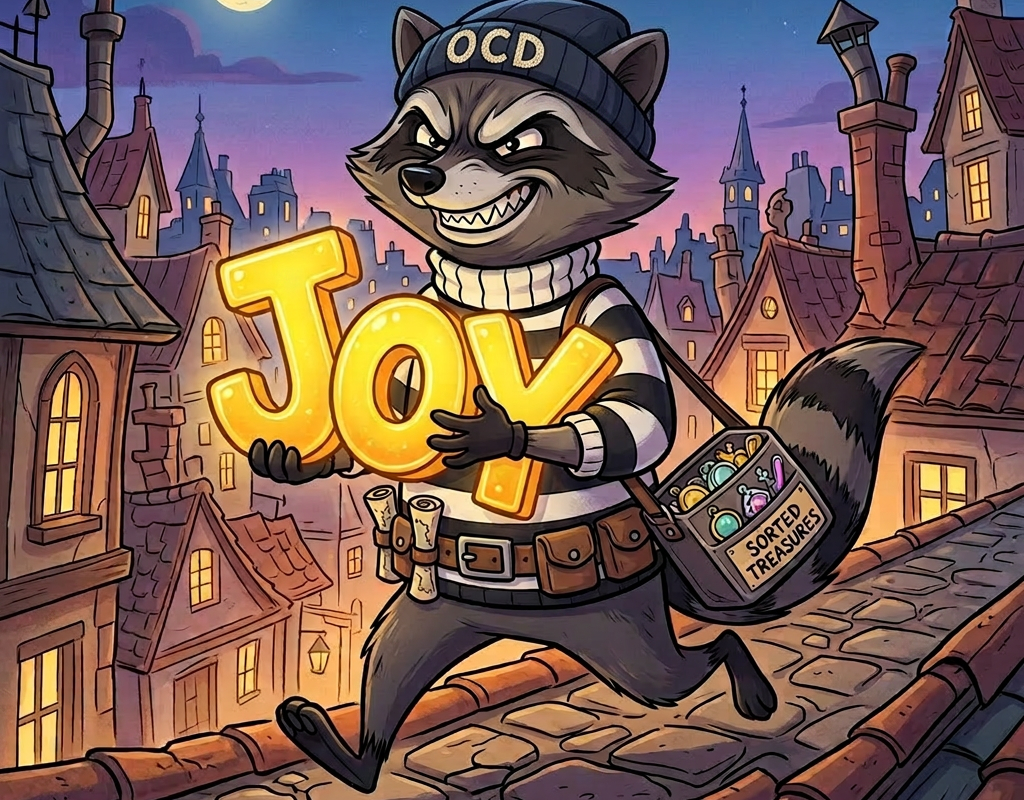
Raccoon wearing a beanie and striped sweater carrying a glowing 'Joy' sign and a bag labeled 'Sorted Treasures'

You may have heard that famous quote:

‘Comparison is the thief of joy’ – Theodore Roosevelt

and well this is no doubt true, I would argue that OCD is actually a pretty good contender too. 

To experience joy, we must be open to experiences, receptive to others and be able to appreciate the world we live in, not only that we also need to feel like we deserve to be joyful.

All of these things require us to be in our parasympathetic nervous system (rest and digest); we need to feel relaxed and at ease with the world around us, not overwhelmed by it.    

Unfortunately when we have OCD, we are rarely in our parasympathetic nervous system, we spend a lot of time in our own heads, dysregulating ourselves (fight or flight) with imagined realities, compulsions and overthinking.  All this means we are less receptive to the world around us, less productive and sadly less able to experience joy. 

Add to this the fact that when you have OCD you don’t always feel like you deserve to have joy in your life.  In fact you can feel quite the opposite, that you’re not a great person and instead of trying to find joy you beat yourself up and make yourself feel even worse! 

Remember, OCD is not your friend, it’s not trying to help you, build you up or make you feel good.  In fact given the opportunity it will tear you down piece by piece until there’s nothing left.  Yes, it sounds brutal and relentless and just like the high school bully, that’s exactly what it is!!!! 

A large student with crossed arms confronts a smaller student smiling and holding books in a school hallway with lockers and bulletin board

OCD – The distractor

I’ve been reading some yoga books recently and I came across the following quote, from Brightening our inner skies (beautiful title) by Norman Blair, which really resonated with me:

My disorderly awareness deprived me in the midst of plenty’ – John Tarrant

In the book Norman talks of reasons people seek out meditation, this was John’s reason. 

You don’t have to have OCD to notice that the mind likes to pull you away from the present.  In fact, in today’s society, with our attention being a source of income for big companies, it’s getting ever harder to just be ‘in the moment’. 

It also resonated with me on an OCD level.  I realised that my OCD constantly pulls me away from the things I care about, my life and family, depriving me from experiencing joy and happiness and disrupting my memories – oh yes, when dysregulated memory gets distorted too. 

How then do we stay present when OCD is so intent on pulling us into an alternate reality, of its own making, to distract us from all that we have and want to be? 

Are you able to pause and notice the nonsense? 

When I have days where the OCD is less sticky, I am able to see the constantly changing nature of thoughts and the mind for what it is.  It’s truly fascinating just how many avenues the mind tries to pull us down daily. 

It’s like standing in the middle of a storm, the wind is trying to pull you in one direction, the rain is pushing you in the other.  Your job is to stand there and watch with no attachment or investment in any way.   

Man in green raincoat with backpack bracing against cold wind and rain by stormy seaside

So much energy and mental effort for what?  In times of dysregulation the brain can take you anywhere and tell you anything and it all seems plausible.  It can make you think that repeating actions, counting numbers, replaying conversations, has a point, when in reality, it’s all just wasted time and energy. 

Once you recognise this and stop, it can all start to feel a bit empty.  Maybe regretful that you’ve wasted so much time and energy on an imagined reality.

How do you feel about finding stillness and being more present?  Is it tricky for you?

Maybe sit now and take a breath, notice what’s around you, feel the ground underneath your feet and the air on your lip as you breath in.

Does it feel easy, hard? 

It can take time, the brain won’t like it to start but think how much more energy you will have and more connected you will feel when you stop letting OCD steal your mental headspace and joy.    

I would love to know your thoughts on my ramblings, do you feel like joy is hard when OCD is loud?  Have you found any good ways to ground and reset your nervous system?

As Always, you are not alone,
Stay Strong xxx

But how do I know if it’s OCD?

Ocean waves forcefully crashing against a rocky outcrop in blue water

Ever heard your OCD brain saying:

‘How do I know if it’s OCD, this time it feels so real!’

This is one of OCD’s biggest hooks and it will throw it at you every single time

Each time you get triggered, for whatever reason, it will feel urgent and like it must be looked at right now!  In fact, if it does feel urgent you should use this as your first clue that it is your OCD at play.

A question I like to ask myself at these times is:

‘Am I struggling?’

If the answer to this question is yes, then use this as your second clue that OCD is playing its nasty game with you.   

One of the reasons we generally fall down the ‘ruminations rabbit hole’ is that we’re not 100% sure whether it’s our OCD, or whether this time the trigger is something to be genuinely worried about. 

But I can guarantee that if you’re struggling with the thought then you’ll be starting to spiral and if you’re spiralling you’ll be heading into your sympathetic (fight or flight) nervous system. 

When in this part of the nervous system we don’t think rationally, as the prefrontal cortex – our thinking brain – starts to go offline and our more primal survival brain starts to take over. 

This is not where we want to be when dealing with OCD thoughts as we don’t think rationally, it’s all about extremes and as a result we end up thinking what OCD is telling us is ‘reasonable’ somehow! 

Honestly the things my brains convinced me are possible when in fight or flight is madness and yet somehow, when in that dysregulated state, it seems perfectly reasonable. 

Here are some examples which might sound familiar:

  • That bump in the road was probably a human which I completely missed.
  • Even though I’ve already washed my hands they’re not clean.
  • What if I push that person into the road as I walk past them?
  • Maybe that red spot is blood, what if I pick up an infection from it?

In fact right now, as I’m writing these down, my brain is saying: ‘What if by writing these things down it makes them more likely to happen? ‘

I mean you get the idea, all the above are situations where OCD has taken 1 + 1 and come up with 20.  It has made huge leaps, completely by-passing any sort of logic, reason or fact and because you are in your sympathetic nervous system, it makes them seem possible! 

In summary,

  1. If it feels urgent
    or
  2. You’re struggling

know that it’s your OCD at play and you need to take a step back, definitely don’t engage!!!

It seems too simple but if you can keep these two ideas in your head when you get triggered then it will empower you to sit with the uncertainty. They also go a long way to helping you identify the thought as OCD and this is a well-known defusion exercise (from ACT therapy) which helps switch the thinking brain back on.

I know it’s unbelievably hard to sit with the uncertainty but know that completing any type of compulsion does nothing apart from validate the OCD trigger, highlights it as important to the brain and sends you off into your sympathetic nervous system (fight or flight) where all logic switches off.

Do your best to not engage with any OCD compulsions, OCD may appear to be your ‘helpful friend’ but it most defiantly isn’t.  Given the chance OCD will steel everything from you, it feels no empathy and will take you to hell if you let it!

I really hope these tips help you as much as they have me,
As always, Stay Strong xxx

Glimmers: Hope Amidst the OCD Noise

GLIMMERS text over a silhouette of a person looking at the Milky Way galaxy.

When you have OCD your brain can feel so loud you think it’ll never be quiet again.  We catastrophise the world, always thinking worst case scenario, our brains are living in survival mode, unable to fully relax.

Anyone suffering from OCD will know how distressing and difficult it can be and at times our brains can feel like very dark places to inhabit. 

When I had my nervous breakdown back in 2021 my nervous system felt so dysregulated that the noise was unbelievably loud and constant!  Waking up was noisy, all day it was noisy and going to sleep was near impossible.    

At times I would sit outside in the garden, feeling pretty numb and watch the birds – mini glimmers I now realise.  I would find awe and beauty in watching them and they helped me remember that life is beautiful.     

What is a glimmer?

A Glimmer is a small, daily moment that sparks joy, safety, awe or gratitude.  It acts as the opposite of an OCD trigger.

I love the word ‘glimmers’ as it speaks to something magical and when you experience them they do feel magical. 

When everything is incredibly loud a ‘glimmer’ can feel like a bright light, pushing its way through the intense darkness – similar to a star in the night sky, all the more beautiful because of the darkness surrounding it. 

My OCD has taken a lot from me over the years but one thing it has given me is the ability to truly appreciate the small, beautiful things in life – which I believe most people miss.    

I can remember a time, not too long after my nervous breakdown, I’d come back from the school run and sat down on the sofa, I then had a moment of quiet.  It wasn’t long and I didn’t recognise the fact until after it had happened, but this little glimmer gave me hope.  It was enough to show me that it was possible for my brain to be quiet again.  This moment has stayed with me and was and still is highly significant to me in my recovery journey.

Can you think of any times when you’ve had a ‘glimmer’? They really are magical moments.

Remember to always look for the light in the darkness, like a moth to a flame, head for that light and hold onto it with all you have.

Remember you are not alone,  
As always, Stay Strong xxx   

Overcoming OCD: Letting Go of the Rope

I have had OCD for what is fast coming up to 30 years. As I quickly approach my 41st birthday it can sometimes feel like I’ve been fighting a war inside my brain for what feels like forever.  I’ve read all the books, listened to the podcasts, had a couple of rounds of therapy, trained as a yoga teacher and PT, I look after my nutritional and physical health, and choose to share what I’ve learnt in the hope of helping others through my blog, Instagram posts and workshops. 

So why I ask myself do I still struggle at times?  Why does the world still feel overwhelming & why won’t my nervous system just relax already? 

Maybe my expectations are too high?  I had a therapist once say to me that I might just have to ‘accept the fact that I’m an anxious person’, not really what you want to hear but then expecting to find total inner peace is probably a little unrealistic too I realise.     

I know Steven Phillipson says, ‘I don’t care how you feel, continue with your day aligning to your values’ and I try to do this. It is in fact how I’ve managed to achieve everything I have over the last 10 years but I do sometimes wonder how much noise is normal?

I wrote in a post a while back: ‘When we have OCD, Fight-or-flight can turn into a trait instead of a temporary state!’ and this is how I feel, like I’m stuck in fight or flight most of the time. My ability to relax, be in the moment and not feel overwhelmed is seriously lacking.    

I feel like I’ve been on a mission the last few years for answers – which I now realise may be a sneaky compulsion of mine, eek!   Maybe what I should have been doing is letting go of the rope – another ACT metaphor which I love.

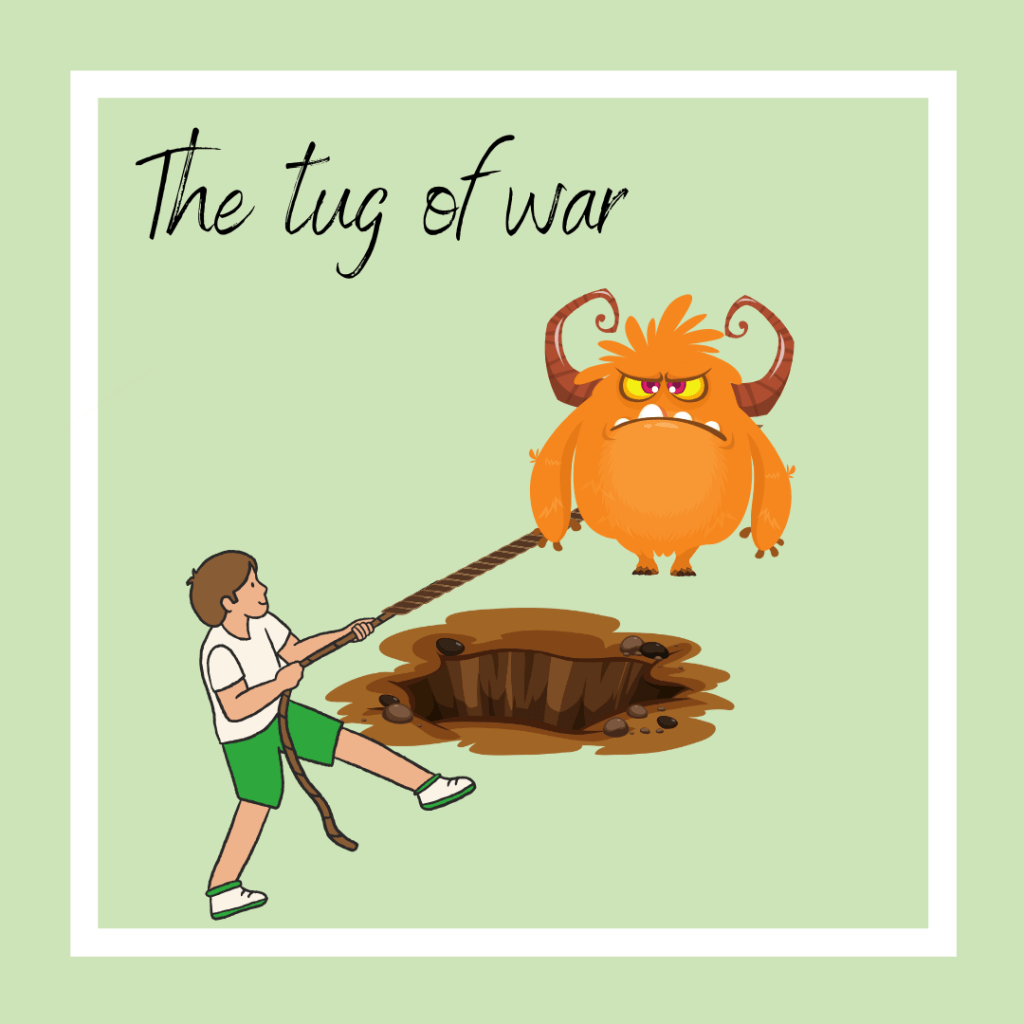
This ACT metaphor illustrates how struggling against your obsessions (the monster) is a never-ending fight, but Letting go of the rope and not engaging with your intrusive thoughts, accepting the presence of them and carrying on with your life while aligning to you values is your way to freedom. 

Breaking it down a bit further:

  • The Monster: Represents your OCD obsessions.
  • The Rope: Represents your attempts to control, avoid, or eliminate these obsessions with compulsions.
  • The Pit: Represents the fear of being consumed by, or drowning in your obsessions.
  • Letting Go: Means dropping the rope (not completing the compulsions) and ceasing the battle, not necessarily defeating the monster (obsession). 

We need to recognise that fighting our obsessions is exhausting and ultimately ineffective, allowing our difficult thoughts and feelings to be present without fighting them is the key, this then frees up energy and attention to focus on what actually matters. 

I wonder then have I secretly been pulling on that rope and keeping my OCD alive with all my research and development?  Argh! Does it all actually come down to my inability to just stop and sit with the feelings?

As I head towards my 30 year anniversary with OCD, I need to acknowledge that some education with OCD is important but then try to recognise where the line is between being informed and it being a compulsion.  

Have you got any sneaky defaults which are keeping your OCD alive and kicking? Do you feel like you’re doing everything right but you’re still struggling too?  

Maybe try and keep a list this week, whenever you notice yourself doing something unnecessary because of your OCD, write it down, awareness is the first step to being able to change these traits, which we have unknowingly accepted into our lives. 

On a more positive note and bringing some hope back into the conversation. I do have the odd occasion when I come out of fight or flight and it feels so wonderful.  It feels like what life should be, I’m present, in the moment and experiencing life as it could be, full of opportunity and joy.  

If I have one target for the next 40 years it’s to spend as much time as possible out of fight or flight and if I can achieve this I will be a very happy soul. I want to be able to enjoy life without rushing through it, listen when people talk, take joy in the small things and the process of getting to them.      

Let me know if any of this resonates with you.  It can be very lonely at times to have OCD, and community can help us feel that less.
A bit of a heartfelt one this week as I approach that 30 year milestone but sometimes that’s what’s needed.

As always, you are not alone,
Stay Strong xxx

ACT Metaphors for OCD Recovery

I’ve written a lot recently about how when we have OCD, if we give into our compulsions we are likely to be plunged into our sympathetic (fight or flight) nervous system.   

This is an issue as when in this state we are unable to think rationally and our intrusive thoughts can feel all overwhelming. 

There are some great ACT metaphors which we can use to illustrate this concept, below are 3 of my favourites, let me know which one’s yours:

1. The fog

When an OCD thought comes in imagine it like fog being blown towards you.  You have the choice, at this stage, to not participate, let the thought be and wait for the fog to dissipate or you can give into the compulsion.  Every time you give into the compulsion, whatever it may be, imagine a new layer of fog being blown towards you, further damping your ability to see clearly.

2.Ripples on a pond

Here the OCD obsession is like a stone being thrown into a pond.  If we do nothing and let it be the ripples will soon disperse and we will be able to see clearly again. If however we give into the compulsion it’s the equivalent of throwing a new stone in every time.

3.The bus stop

Here we see that before we are triggered we are standing at the bus stop watching the traffic go by.  If we then get triggered and give into the compulsion it is the equivalent of walking out into the road and being surrounded by the traffic, therefore not being able to see clearly.

There are plenty more of these metaphors out there, if you’ve found these ones helpful why not have a look around for some others or if you know of another helpful one then add it in the comments below, I’d love to hear it. 

I do think the metaphors can make it all seem very easy to just draw yourself back out of fight or flight. I don’t for a second want to belittle how hard this is to do when you’re in it, believe me I know, but it can help to show what the effect of giving into an OCD compulsion can be and hopefully it gives you another tool and incentive to not give into those compulsions when they come along, they really do only lead to misery. 

I really hope it helps, as always remember you are not alone.
Stay Strong xxx 

Overcoming OCD: The Power of Choice

I have recently had the pleasure of coming across the choice article written by Dr Steven Phillipson – a licensed clinical psychologist who specialises in Cognitive-Behavioural Therapy for OCD.  It’s such an extraordinary piece of work and a must read for anyone suffering from OCD.  It is quite lengthy but there is an audio version here.

The focus of the article is how we need to see OCD thoughts as irrelevant and that we DO have a choice when it comes to this decision.

I know only too well when you have OCD you can feel like you have no choice but to do the compulsion when the thoughts come in, the doubt & uncertainty that comes with not knowing 100% whether the thought is significant can feel too much to bear. 

However, we need to start to see this part of the brain as an independent system from our conscious thoughts, one that works automatically – like the systems which control automatic functioning in the body such as breathing and heartrate.  We do this by becoming aware of our automatic thoughts and autopilot, making the choice to carry on with our day, align with our values and see the thoughts as meaningless and irrelevant – because they are.  

Below is a quote from the article which I thought was helpful:    

‘what do our feelings say about our fundamental beliefs? I believe that the answer to this question is, “Not necessarily very much.” Our feelings are not a reliable measure of our self-perception. Why? Because automatic thoughts can create feelings that are just as convincing as thoughts that reflect our deeply held beliefs. So, it is vital that we do not reflexively take the thoughts and feelings that our brains send to us at face value.’

Here Dr Steven Phillipson is highlighting the fact that automatic thoughts can create feelings, these feelings can make things feel more real.  Therefore, we shouldn’t put too much emphasis on how we feel as feeling are NOT within our control. 

Why would we give up our autonomy (our right to make informed decisions about our lives) to something we have NO control over? (Remember, we cannot control our thoughts and feelings only our behaviours. )

Another great quote from the article:

‘Remember when you have OCD, you cannot use your feelings to determine if a threat is ”real”.  Doing so is a little like asking the Devil for directions to heaven’.

I always remember this quote when I’m starting to spiral as it happily reminds me that I cannot trust those feelings.

The article highlights how when one has OCD the amygdala – whose primary function is to process emotions, especially fear and anxiety – is sending us a faulty signal that there is something which needs our attention right away and cannot wait. Our job – through ERP therapy – is to become habituated (the process of making or becoming accustomed or used to something.) to this alert. 

This is no easy task and can feel very uncomfortable. Choosing to ignore your brains warning system and take the chance that it’s a false alert can truly feel like jumping out of an aeroplane not knowing whether your parachute is packed correctly. However this is the chance we have to take to show the brain that the signal was faulty, we literally do nothing about the thought and carry on with our day aligning with our values.

More on habituation coming in future posts but for now I’m going to leave you with this motivational mantra which I use all the time,

Every day is a new opportunity for me to show my brain that this continued prompt is meaning and irrelevant. 

I really hope it helps you too:
As always, stay strong xxx

2 Simple Questions to Easily Dismiss OCD Thoughts

No matter how many years I’ve had OCD and how many tools I have in my toolbox, there does still seem to be times when a thought will, pop up and for whatever reason it gets a bit stuck. 

I find it particularly frustrating after all the work I’ve put into my recovery but somehow my brains default mode does seem to be to doubt & worry and so I must be proactive about using the tools I’ve learnt along the way to keep my mental health in check. 

One tool which I find endlessly helpful to dismiss OCD thoughts is one I learnt from Byron Katie. 

It’s worth noting here that in an ideal world we wouldn’t invest any time in the thoughts, we’d let them be but if they do stick – for whatever reason – then take 5 minutes and give this tool a whirl.

Byron Katie calls it ‘The Work’ and it takes the form of a set of questions:

As yourself

  1. Is it true? (Yes or no. If no, move to question 3.)
  2. Can you absolutely know that it’s true? (Yes or no.)
  3. How do you react, what happens, when you believe that thought?
  4. Who or what would you be without the thought?

The tool seems too simple right, but it is unbelievably good.

I love Byron Katies version, but I have found that I don’t need the whole version to be able to dismiss my OCD thoughts. All I generally need to do is ask myself,

Is it true? 

Quite often when I ask myself this question it isn’t obvious what my brain is obsessing over at all!  OCD can be so vague – after all fear lives in the vague – and when I dig down a little deeper the true fear is often nonsense.  Sometimes this is enough on its own for me to dismiss the thought! 

If not, I ask myself

Is it 100% true?

With OCD the answer is always NO, because OCD is about doubt and uncertainty and so I can guarantee you won’t know 100%. 

Next, I tell myself

If it’s not 100% true, then,

‘YOU HAVE TO LET IT GO!’

Why would you torture yourself over something which isn’t 100% fact?  The brain is looking for certainty which you cannot give it, so let it go.

And this is enough for me to sit with the thought and let it be. 

Just two simple questions:

  1. Is it true
  2. Is it 100% true?

I cannot tell you how many times this method has helped me.  I really hope it’s useful for you too. Let me know in the comments below

As always
Stay Strong xxx

Top 5 Triggers That Worsen OCD Symptoms

Honestly this list could easily be, ‘100 things which make OCD worse’, there are so many of them but for efficiencies sake the top 5 I’ve always found are:

  1. Overthinking/ruminating on your thoughts, feeling & emotions – this never ends well! Something it’s important to learn quickly with OCD is that YOU CAN’T OUTTHINK YOUR THOUGHTS! Believe me I’ve tried. The more you tumble down the rabbit hole the more anxious and irrational you get.
  2. Night-time – yep at night our logical brain takes a rest and the emotional brain is more active as a result. This brain is much less rational and can catastrophize extremely well. The trick at night time is to realise this and dismiss any irrational thoughts that come in between 11pm and 7am. You’ll feel so much more capable of dealing with them in the morning.
  3. If basic needs aren’t being met – HALT is a great acronym for this, if your feeling; Hungry, Angry, Lonely or Tired know that you’ll be less able to deal with intrusive thoughts when they come in. Try to manage these 4 things well throughout your days.
  4. If you’re very stressed – If you’re stressed for whatever reason your body will already be on high alert. Be mindful that when in this state thoughts will feel more sticky, catastrophic and black and white.
  5. If you haven’t moved your body enough – Movement creates endorphins in the brain which are our bodies natural de-stressors. We were built to move and as a result we feel better when we do.
  6. A sneaky 6th one for the ladies – when we’re on our periods resilience can also be lower and so be kind to yourself during this time and know the thoughts will feel more sticky.

Let me know what you think and whether there’s any you’d add to the list. Keeping everything in balance when tackling OCD can be tricky. However, it will set you up to succeed in the long run.

Stay Strong xxx