Conquering OCD: Recognizing Fight or Flight Responses

In my last post I talked about the threat bucket metaphor and how it relates to our resilience levels – if you haven’t read that one you might want to go and check it out first – link to pervious post.

In this post we’re going to look closer at why it’s particularly bad for your bucket to overflow when you have OCD and why your self-care is of the upmost importance. 

Why it’s so bad for OCD when your bucket overflows?

When we have OCD we want to do everything we can to keep our resilience as high as possible, why? 
Well, when in fight-or-flight, our brain shifts into ‘survival mode’ this, like OCD, changes how you think, not just how you feel.

Our goals switch to speed and safety over accuracy, nuance and long-term reasoning – not what we want when dealing with OCD intrusive thoughts. 

Here’s a summary of what’s happening in the brain when our resilience drops (bucket overflows).

1. Our brain’s “thinking centre” goes offline – The prefrontal cortex (responsible for reasoning, planning, empathy, and impulse control) becomes less active.

This means:

  • We have a reduced ability to think logically
  • Difficulty seeing multiple perspectives
  • Poor working memory (“I can’t think straight”)
  • And more impulsive reactions

You’re not choosing this—blood flow and neural activity are redirected away from this area.

2. Our threat-detection system takes over – our amygdala and related limbic structures start to dominate.

This means our thinking becomes:

  • Threat-focused (“What’s wrong?”)
  • Binary (safe vs dangerous, right vs wrong, black vs white)
  • Fast and reactive
  • Emotion-driven

Our brains are asking one question only: “How do I survive this?”

3. Cognitive narrowing occurs, Fight-or-flight (an overflowing bucket) causes tunnel thinking.

You may experience:

  • Fixation on one detail or outcome
  • Loss of creativity and flexibility
  • Difficulty accessing learned skills – this is why prepping in advance for triggering situations is so important
  • Overgeneralization (“This always happens”)

This is efficient for survival—but limiting for problem-solving and not where you want to be when experiencing intrusive thoughts.

4. Biases increase – in survival mode, the brain relies on shortcuts, common thinking patterns include:

  • Catastrophizing
  • Mind reading (“They’re against me”)
  • Personalization
  • Black-and-white thinking

These are not “bad habits”—they’re stress (OCD)-induced neural shortcuts.

Understanding all this helps you realise that you can’t reason or ruminate your way out of fight-or-flight (OCD)—you regulate your nervous system first. Thinking comes back after ‘safety’ is restored.

BUT…
…how do we know if we’re in fight or flight in the first place?
and
…how do we get out of it and stay out of it when our amygdala keeps letting off faulty signals all the time?
I hear you ask.

Honestly it can feel impossible at times, I get it! 

First things first, the best way I’ve found to work out if I’m in fight or flight is from Martha Beck:

Ask yourself:
‘Am I suffering/struggling?’

If the answer is, ‘yes’ then you can almost guarantee you’re in fight or flight.   
There’ll be no logic involved, you won’t be thinking rationally – you need to stop.    

Our bodies are designed to move between rest and digest and fight or flight naturally and if you can recognise you’re dysregulated and sit with the uncomfortable feeling then great, do that.

I have however found some nice ways to speed up the process, so you can start to see things more rationally more quickly!   

Here are some of the best tools I’ve found to come out of fight or flight when in it:

  1. Creativity – this will mean different things for different people but creativity is amazing at switching on a different part of the brain, drawing your attention away from the catastrophizing part. Quite often if you can focus on creating something, whether it be a piece of art, a yoga sequence, something in the kitchen, garden, workshop, on the computer, anything that gets you thinking outside the box, you will start to draw your attention back to a more balance place.
    What’s your creative outlet?
  2. Curiosity – This can be curiosity about anything, quite often when we become curious and interested in something it grounds us and pulls us away from that extreme black and white thinking. Try asking why? Maybe investigate how something works or why it’s the way it is.
    Have you ever wondered about anything?
  3. Humour – is fabulous for getting the brain to switch modes. It works because its unexpected, remember the brain is a prediction machine and it’s pretty good at it. When a joke comes along and it doesn’t end where the brain think it will, BAM! You’re out of default mode and the brain is switched on and listening.
    Do you like any particular comedians? Go and look up one of their new sets online.
  4. Awe – part of the joy of being human is our ability to find awe. It can really give you some perspective when you look at the stars, birds, clouds, landscape etc. Going out into the world and finding things that make you think, wow! Is very important to our wellbeing and it helps us reset.
    What brings you that feeling of awe?
  5. A Challenge – this can be tricky when you’re in fight or flight but something which I found fun – from Martha Becks book – was to try and write your signature backwards. It takes a huge amount of focus and is very grounding. Go on, give it a try!
  6. Foundations Work – movement, nutrition, sleep, relaxation & social connection.  This takes an element of doing what you know is good for you, even when you don’t feel like it. We have to take action first, do the things we know make us feel better in the long run, your body and brain will thank you.

I really hope some of these methods are useful for you, give them a go and see what works.  It can be very individual which is tricky but once you’ve found the thing that works it can be seriously life changing.  Once back in rest and digest quite often we can let the thought go and see it as completely irrational, but if not, at this stage we can work through Byron Katies, questions.

Ask yourself:
Is it true?
Is it 100% true?  If the answer is no – which it always is in the case of OCD as it is based in doubt and uncertainty – then:

YOU HAVE TO LET IT GO!!!!!!

As I said in one of my previous posts, why would you torture yourself over anything less than 100% certainty?

I really hope this post has helped you to understand the role the nervous system plays in OCD and why it’s so important to recognise when you’re in fight or flight and find useful ways to bring yourself back. Only when out of fight or flight can we rationalise, think clearly and see OCD thoughts for what they are, just thoughts.

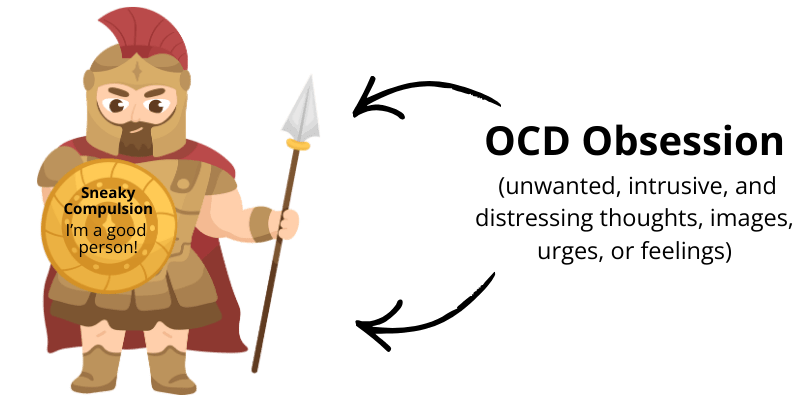
And if you ever wanted a reason not to complete a compulsion in the first place then remember, every time you give into one of those unwanted, intrusive, and distressing thoughts, images, urges, or feelings you’re filling up your bucket a little bit more and getting closer and closer to fight or flight, where it all starts to fall apart! 

Leave that thought be and carry on with your life aligning to your values. 

I really hope this post helps, education and knowledge are so vital for OCD recovery,
As Always, you are not alone,

Stay Strong xxx  

Understanding Thought-Action Fusion in OCD

Thought-action-fusion is a common cognitive distortion associated with OCD.  It’s where a person believes that having a thought is equivalent to performing an action, or that thinking something makes it more likely to happen.

It is a very important distortion to be aware of if you’re suffering from OCD as when you’re in fight or flight mode – talked about in my previous post – anything can feel possible.     

Remember when we are suffering from OCD we are highly likely to be in the fight or flight (sympathetic) part of our nervous system. When in fight or flight our ability to think rationally goes out of the window and so things that we know to be impossible, when in our rational minds, can feel possible! 

When struggling and ruminating on an OCD obsession the brain and body are suffering with high stress (fight or flight), when in this state our memory becomes selective and fragmentedOur attention narrows (tunnel vision) and our hippocampus (memory organiser) works less efficiently.

The result of this is that we can get gaps in our memory, Out-of-order recall and confusion about timelines. In addition to this the brain searches for danger-related memories, and the Safe or neutral memories are harder to access. 

It’s important to note that a Strong memory ≠ accurate memory.  Stress increases confidence in memory and emotional intensity but decreases, detail accuracy, context and perspective! 

All this results in intrusive memories feeling more real because they’re emotionally tagged

  • “What if” thoughts feel urgent due to amygdala activation
  • Memory distrust develops (“What if I forgot something important?”)

This fuels checking, reassurance, and rumination.

For me this was one of the most enlightening distortions to learn about.  Following my nervous breakdown, I was constantly in my sympathetic nervous system and so I had a few events when an intrusive thought occurred, and I couldn’t remember clearly/rationalise it/work it out, this caused me unbelievable distress. 

Thought-action-fusion can make you feel like a thought is real and because of your mental state your inability to rationalise that distortion feeds the uncertainty.  We need to recognise this pattern when it happens for what it is and reduce the impact by:

  • Not trying to ‘figure it out’ while anxious – this includes during the night, no analysis between 11pm and 5am remember! 
  • Remembering that you’re in fight-or-flight, you’ll be thinking in extremes and this is not evidence.
  • Find ways to reset and come back into the parasympathetic nervous system (rest and digest). 

I really love Byron Katies method for this where we say:
Is it true?
Is it 100% true? 

If the answer to the second question is no – which it will be because the stress is based on doubt and uncertainty, then ‘you have to let it go’.   

Why would you torture yourself over anything less than 100% certainty? 

Fear lives in the vague after all and it’s my guess, it’s just a thought (obsession), attached to a feeling of uncertainty, that you’re basing your rumination on, not facts. 

Your brain is probably desperately trying to work out whether there is something genuine to be concerned about, you should take this as your sign that there isn’t!   

I really hope this helps, OCD recovery isn’t easy and sometimes thought-action-fusion can get worse when we are in recovery and start to let our guard down, but know and trust who you are and as always,

Stay Strong xxx

Expect and Accept: Overcoming OCD Thoughts

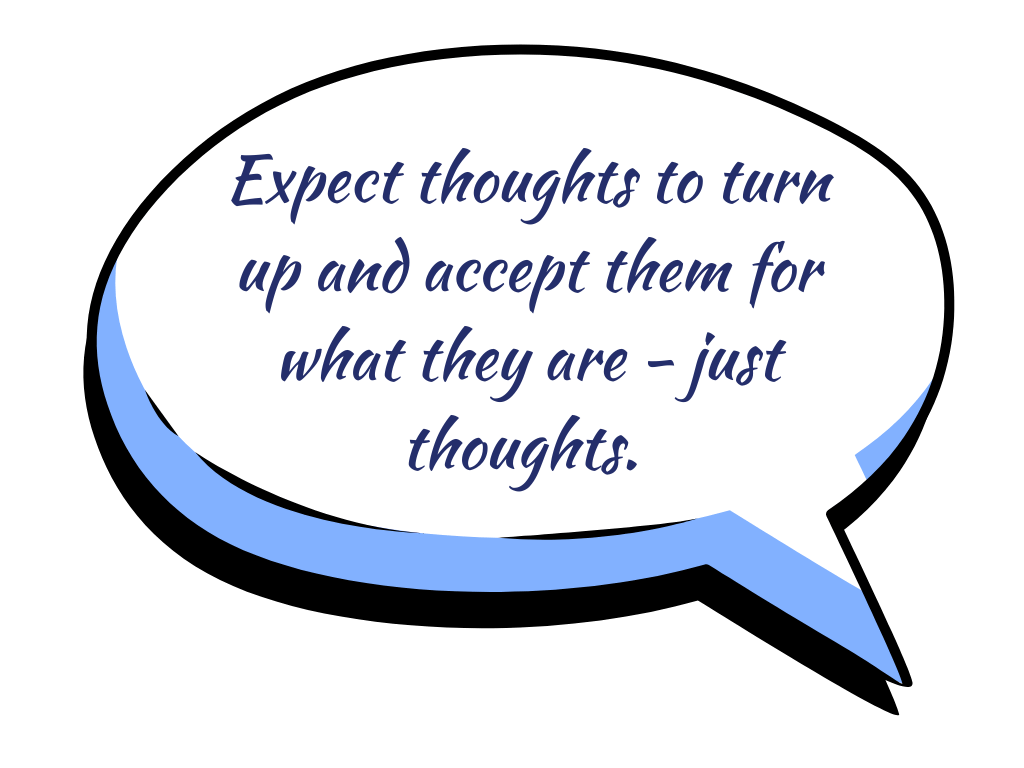
‘Expect and accept’, is a new mantra I’ve been trying out recently. 

I’ve found It can be helpful when managing OCD thoughts day-to-day to have a mantra to act as a ‘switch’ for the brain, helping you to label the thoughts as OCD and move on. 

Obviously in an ideal world you wouldn’t need it but it can be so easy at times to get dragged into OCD thoughts and before you know it, you’re freefalling down a rumination rabbit hole and all sense of reality has gone.

Don’t be fooled by the cute bunny, he may appear to be your friend but believe me he isn’t!

At times like this it can be so helpful to have a little reminder, like a therapist in your ear, saying to you:

So let’s be clear here, by saying ‘expect it’, I’m not saying, lets invite those thoughts along or will them to be there.  It’s more about having an awareness that if you’re going into a triggering situation, a new environment or out of your comfort zone, then it’s highly likely that your OCD will want to come along for the ride. 

I’ve found at times that I can get frustrated with my OCD when it turns up and what I’ve learnt over the years is if you don’t want it to be there, then it’s almost guaranteed to be.

When it does, if it does, we need to accept it.  We can do this by saying, ‘Thank you, brain that’s exactly what I wanted to hear right now’.

After all OCD recovery is not about getting rid of the intrusive thoughts, this is a common mistake, remember everyone gets them. So it’s more about allowing them to be there and then carrying on with your day regardless, aligning with your values. 

I realise how hard this is, but know that you are not alone and that every time you carry on with your day, despite the thoughts, you are making progress and the brain is learning it doesn’t need to freak out at every thought that comes into your mind.  

Why not give the mantra a go this week and see if it helps you too. Let me know how you get on in the comments below.

Remember: ‘Expect it and Accept it’

As always,
Stay Strong xxx

The Role of Values in Overcoming OCD

I’ve mentioned values in several posts to date, and I feel it’s time to take a closer at them and why they are so important in OCD recovery. 

What’s a value anyway? 

Lets start at the beginning, a value is: ‘a principle or standard of behaviour; one’s judgement of what is important in life’.

They are the standards we set for ourselves to live by, they outline the things that are most important to us and help guide us with our daily choices. 

If you’ve done any ACT (acceptance commitment thearpy), then you will know that values work is one of the 6 core principles

They describe values as something you, ‘do’ rather than ‘have’. They are verbs not nouns, general directions and guiders for life, a place you can never arrive at but are always striving towards.  

From this description they can feel quite nebulous, but they are the invisible building blocks of our lives. 

How do you work out your values?

There are lots of great exercises online that you can work through.  Here are a couple of links to try but a quick google will find you lots of information on the topic.

Values worksheet 1

Values worksheet 2

If you’ve never done this work before then I advise spending a bit of time working through one of the above activities. 

So why are values so important in OCD recovery? 

They become especially useful when you are struggling because you can align to your values and know that that’s the person you want to be. 

You can then take actions towards your values, regardless of the thoughts and how you feel, which is exactly what we need to do when OCD gets loud.

OCD has a nasty habit of making you think you’re the worst person in the world, capable of distressing and horrible things and when you’re spiralling it can be incredibly hard to pull yourself out.

Your values then become a superpower, acting as your anchor during these difficult times.  They remind you of who you truly want to be and allow you to proactively take action to align with them. 

Say for example that your values are to be an honest, trustworthy, reliable, kind and loving person, then when OCD is telling you otherwise you have the opportunity to say;

‘No OCD, I’m not who you’re telling me I am, I know my values and I’m going to carry on with my day aligning to them’. 

The brain believes what it sees, so if you live your life aligning to your values then you will be banking undisputable evidence of who you are. The OCD thoughts then become much easier to dismiss and don’t take hold as easily. 

In addition to this it’s worth remembering here that OCD thoughts are ego-dystonic, which refers to the fact that the obsessions and compulsions are inconsistent with a person’s values, beliefs, and self-image, understandably causing a lot of distress.  

When going through OCD therapy and recovery it can feel so tough at times and your values can act as your guiding light through the darkness. 

Every time it feels overwhelming and tough, you need to remind yourself of your values and ask yourself;

‘If I’m aligning with my values and the person I want to be then what would I do in this situation?’  

  • Would I drive back and check if that bump in the road was a person or would I carry on with my day?
  • Would I wash my hands again because they still feel dirty or would I just carry on with my day?
  • Would I spend hours ruminating over the nightmare I had last night and not make it into work, or would I just carry on with my day?

There are endless scenarios you could use here but ultimately you have to ask yourself, is your OCD holding you back from the values-based life you want to live? 

I’m guessing the answer is yes.   

The amazing thing about doing values work, is that once they’re in place they allow your life to become more focused and meaningful in all ways.  You become empowered to let anything that doesn’t align with them go, which quite often results in a lot less drama, mental health struggles and a lot more peace.

I’d love to know if you have also found ACT therapy and Values work helpful in your OCD recovery, please share your insights below.

As always,
Stay Strong xxx

Overcoming OCD: The Power of Choice

I have recently had the pleasure of coming across the choice article written by Dr Steven Phillipson – a licensed clinical psychologist who specialises in Cognitive-Behavioural Therapy for OCD.  It’s such an extraordinary piece of work and a must read for anyone suffering from OCD.  It is quite lengthy but there is an audio version here.

The focus of the article is how we need to see OCD thoughts as irrelevant and that we DO have a choice when it comes to this decision.

I know only too well when you have OCD you can feel like you have no choice but to do the compulsion when the thoughts come in, the doubt & uncertainty that comes with not knowing 100% whether the thought is significant can feel too much to bear. 

However, we need to start to see this part of the brain as an independent system from our conscious thoughts, one that works automatically – like the systems which control automatic functioning in the body such as breathing and heartrate.  We do this by becoming aware of our automatic thoughts and autopilot, making the choice to carry on with our day, align with our values and see the thoughts as meaningless and irrelevant – because they are.  

Below is a quote from the article which I thought was helpful:    

‘what do our feelings say about our fundamental beliefs? I believe that the answer to this question is, “Not necessarily very much.” Our feelings are not a reliable measure of our self-perception. Why? Because automatic thoughts can create feelings that are just as convincing as thoughts that reflect our deeply held beliefs. So, it is vital that we do not reflexively take the thoughts and feelings that our brains send to us at face value.’

Here Dr Steven Phillipson is highlighting the fact that automatic thoughts can create feelings, these feelings can make things feel more real.  Therefore, we shouldn’t put too much emphasis on how we feel as feeling are NOT within our control. 

Why would we give up our autonomy (our right to make informed decisions about our lives) to something we have NO control over? (Remember, we cannot control our thoughts and feelings only our behaviours. )

Another great quote from the article:

‘Remember when you have OCD, you cannot use your feelings to determine if a threat is ”real”.  Doing so is a little like asking the Devil for directions to heaven’.

I always remember this quote when I’m starting to spiral as it happily reminds me that I cannot trust those feelings.

The article highlights how when one has OCD the amygdala – whose primary function is to process emotions, especially fear and anxiety – is sending us a faulty signal that there is something which needs our attention right away and cannot wait. Our job – through ERP therapy – is to become habituated (the process of making or becoming accustomed or used to something.) to this alert. 

This is no easy task and can feel very uncomfortable. Choosing to ignore your brains warning system and take the chance that it’s a false alert can truly feel like jumping out of an aeroplane not knowing whether your parachute is packed correctly. However this is the chance we have to take to show the brain that the signal was faulty, we literally do nothing about the thought and carry on with our day aligning with our values.

More on habituation coming in future posts but for now I’m going to leave you with this motivational mantra which I use all the time,

Every day is a new opportunity for me to show my brain that this continued prompt is meaning and irrelevant. 

I really hope it helps you too:
As always, stay strong xxx

OCD – The thoughts are Irrelevant

Lady with thoughts above her head.

Paradoxically the word irrelevant has become extremely relevant in my life recently.  

It is exactly what we have to see OCD obsessions (unwanted, intrusive, and distressing thoughts, images, or urges that repeatedly enter a person’s mind, causing anxiety or distress) as. 

It sounds so easy but when your brain is telling you there is danger right here, right now and it’s letting off all the warnings signals, it can feel like you’re going against every natural instinct you have, not to do the compulsion (repetitive physical or mental behaviour a person feels driven to perform to alleviate the anxiety, distress, or unease caused by an obsession) and find that momentary relief.    

This is why it feels so hard, the brain – for whatever reason – has let off it’s fight or flight response.  The job of this system is to make you remove yourself from danger/discomfort. To act in opposition to this response is to go against your natural instincts. 

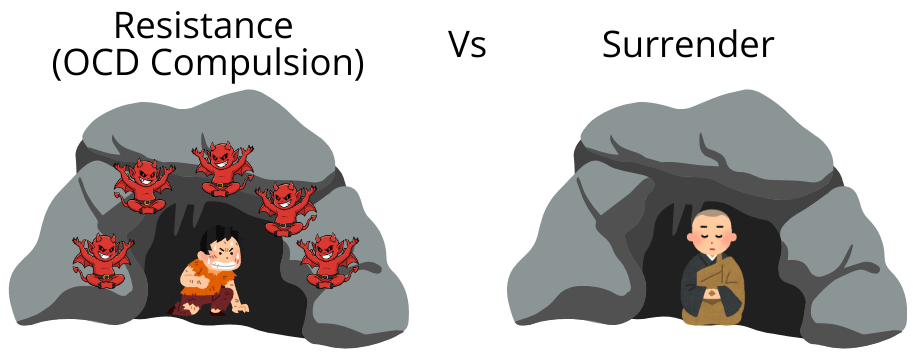
OCD is a fault in this system, the brain is alerting you to danger where there is none and it can only learn this when you sit with the uncomfortable feeling and go about your day as if the thought is completely irrelevant. 

No matter how you feel, you must carry on with your day and allow the brain to learn that the signal is a false alarm.  In contrast by giving into the compulsion you never give your brain a chance to see that there was nothing to worry about in the first place. 

The focus should be on living a valued based life and not trusting your feelings to guide you. Feelings are out of our control and so allowing them to dictate your actions is foolish. 

Decide on your values and live each day in accordance with them regardless of how you feel.  This way the brain learns it doesn’t need to complete a compulsion for every random obsession that pops into your head. 

This is also how the brain starts to heal and your scared amygdala (the part of the brain responsible for triggering your fight or flight response) which keeps letting off these false alerts, learns that it doesn’t need to be so scared anymore.  This does take time and I’m still in this process myself but having the knowledge that the current signals are faulty, and your brain is just a bit scared is so empowering. 

It can be very frustrating at times when you have OCD and easy to beat yourself up about it but Martha Beck tells us to imagine our amygdala as a scared animal. Would you say cruel things to a scared puppy, or would you show it kindness and love?  We all need to be a bit kinder to ourselves and realise that OCD is just our brain being scared incorrectly. 

See each day as an opportunity to get stronger and show the brain that these faulty signals are meaningless and irrelevant!

I know this work is hard, but you are not alone, you are not a bad person, and you are braver than you know. 

As always,
Stay Strong xxx

Don’t miss another post, subscribe today.

2 Simple Questions to Easily Dismiss OCD Thoughts

No matter how many years I’ve had OCD and how many tools I have in my toolbox, there does still seem to be times when a thought will, pop up and for whatever reason it gets a bit stuck. 

I find it particularly frustrating after all the work I’ve put into my recovery but somehow my brains default mode does seem to be to doubt & worry and so I must be proactive about using the tools I’ve learnt along the way to keep my mental health in check. 

One tool which I find endlessly helpful to dismiss OCD thoughts is one I learnt from Byron Katie. 

It’s worth noting here that in an ideal world we wouldn’t invest any time in the thoughts, we’d let them be but if they do stick – for whatever reason – then take 5 minutes and give this tool a whirl.

Byron Katie calls it ‘The Work’ and it takes the form of a set of questions:

As yourself

  1. Is it true? (Yes or no. If no, move to question 3.)
  2. Can you absolutely know that it’s true? (Yes or no.)
  3. How do you react, what happens, when you believe that thought?
  4. Who or what would you be without the thought?

The tool seems too simple right, but it is unbelievably good.

I love Byron Katies version, but I have found that I don’t need the whole version to be able to dismiss my OCD thoughts. All I generally need to do is ask myself,

Is it true? 

Quite often when I ask myself this question it isn’t obvious what my brain is obsessing over at all!  OCD can be so vague – after all fear lives in the vague – and when I dig down a little deeper the true fear is often nonsense.  Sometimes this is enough on its own for me to dismiss the thought! 

If not, I ask myself

Is it 100% true?

With OCD the answer is always NO, because OCD is about doubt and uncertainty and so I can guarantee you won’t know 100%. 

Next, I tell myself

If it’s not 100% true, then,

‘YOU HAVE TO LET IT GO!’

Why would you torture yourself over something which isn’t 100% fact?  The brain is looking for certainty which you cannot give it, so let it go.

And this is enough for me to sit with the thought and let it be. 

Just two simple questions:

  1. Is it true
  2. Is it 100% true?

I cannot tell you how many times this method has helped me.  I really hope it’s useful for you too. Let me know in the comments below

As always
Stay Strong xxx

OCD – How to know if you should pay attention & why we don’t trust ourselves.

I wrote last week about trust being maybe the most important thing in OCD and Anxiety recovery.  I’ve been using this concept over the last week in my OCD work and there really does seem to be something in it. 

Ultimately OCD thrives on doubt, and that doubt is in yourself and your ability to cope with whatever situation life/your brain throws at you.  It’s our inability to trust that when placed in a situation, we’ll take the right action/make the right decision/act in accordance with our values/be able to cope with the whatever’s thrown our way.

So why don’t we trust ourselves?  Who or what has made us doubt our own mind & judgement?

We’re generally told not to go looking for reasons we have OCD in therapy and the current belief – or so I understand – is that it is potentially a mix of genetics & life experiences but as far as I know there are no certainties here.    

Ultimately, we don’t need to know why we have it to recover from it, but it is my belief that OCD is often triggered when we’re in periods of heightened emotional stress.   Potentially trauma but also new mums, big life changes, times when our parasympathetic nervous system – fight or flight – is more active for whatever reason. 

When in this mindset (fight or flight) we think less rationally (trust ourselves less), our emotional brain is more active and so the thoughts that come up could potentially be stickier/more triggering to us. 

I know when my OCD/anxiety has been triggered, for whatever reason, I am then more vulnerable to other OCD thoughts/triggers – a reason ERP can be so hard.  When I’m back in my sympathetic nervous system – rest and digest – often I can dismiss THE SAME THOUGHTS easily (I trust myself). 

Another example of this is at night when the rational side of the brain (prefrontal cortex) winds down for a rest and the emotional side of the brain takes control.  Ever thought something in the middle of the night and freaked yourself out, not been able to get back to sleep and then in the morning thought, what the…….???? Yep, that’s what OCD feels like.  The logical part of the brain seems to switch off and you’re in fight or flight, thinking in black and white, able to convince yourself that up is down and potentially you could secretly be a psychopath/murderer/paedophile/whatever your current theme may be. 

This emotional part of the brain is powerful – imagine it like an elephant and the logical thinking part like the rider.  The rider cannot control the elephant; it must work with it otherwise it will take control.

We regain our trust and switch the logical brain back on by sitting with the thoughts and doing, well, nothing.  This, when you’re in fight or flight is terrifying, almost impossible at times.  Your brain is desperate to work it out, it feels like it needs to know NOW!  But that need and desperation is your sign that you are spiralling, and you actually need to do nothing

I read Martha Becks new book, Beyond Anxiety, recently – some great bits in there for anyone who like to read – and she used the phrase,

 ‘If you’re struggling, then you’re spiralling’

which I really liked, because it’s not always easy to detect whether it’s your OCD/anxiety calling the shots or whether it’s actually something you should be paying attention to. In fact your brain will be telling you it’s the only thing you should be focusing right now. But if you’re suffering/struggling/distressed you can trust that you’re not being rational, and it IS your anxious OCD brain catastrophising. 

Once the logical brain switches back on, you’ll easily be able to rationalise the thoughts – I promise. 

I also know that when OCD is bad, the amount of time you spend out of fight or flight is low.  I can remember when I had my nervous breakdown, I thought my brain was never going to go quiet – ever.  And then one day I noticed I had a few seconds when it was and I thought, YES, it is possible, but it takes time, I’m not going to lie, it’s tough.  So know that if your OCD is currently bad, you may not be thinking rationally much of the time!   

You might not think this right now, so I’m going to tell you. You are a good person, you are worth it, and there is light at the end of that tunnel, so never give up. 

Stay strong – you are not alone xxx

OCD – 4 things that are helping right now

I’m sad to see that It’s been just over a year to the day that I’ve written a full post.  I have been updating social media a bit and in all honestly I was considering letting this blog go, but I’ve just read some of the comments and I’ve realised that that’s not an option so I’m back!    

I started conquering OCD in 2017 when my mental health was in a pretty good state.  I felt strong and as though my OCD had pretty much gone – if only I had known what was coming my way!  I have been on a rough ride the last two years after a series of events ‘took me down’, so to speak.  I jest and I can start to laugh about it now but I really have been to hell and back. 

The upside of my ‘journey’, man I hate that word, is that I have learnt LOADS and so now I am able to share all this knowledge with you guys. 

To get us started again here are four things that are helping me right now: 

Exercise – I practice yoga daily as I teach – I realise this sounds a bit ‘perfect’ and I want to make it clear that I am very far from that. Sometimes a daily practice is just 5 minutes on the mat but showing up every day no matter what, tells my brain that I can do hard things.   I also love box fit classes, this gives me the cardio I need but can also be quite triggering for my OCD.  I quite often have to deal with intrusive thoughts of ‘what if I hit the person in front of me by mistake’ or if the face of someone I love pops into my head during a boxing sequence, OCD really is the gift that keeps giving. 

I know for a lot of people it’s hard to fit the exercise in but it doesn’t have to be big workouts at the gym.  It can be walking the dog or just taking the stairs instead of the lift.  I’ve heard it said that exercise can be as effective as SSRI’s for mental health so it’s got to be worth a try right?    

Reducing caffeine – This ones so super tough!  The brain likes patterns and routine and so most of us nowadays are addicted to tea or coffee, or whatever hot beverage you enjoy.  This is why I’ve put reducing rather than eliminating.  If we tell the brain, you can’t have something, it’s going to get mad at you but if we just try and substitute that third cup of coffee for a hot water you might be surprised how easy it is.  Most of the time I find that the brain just likes the habit of making the drink and the feeling of sipping something warm and comforting rather than the coffee itself.  Hot water will tick all of those boxes, so why not give it a try?  Also try not to drink caffeine too late in the day, it’ll mess with your sleep, which if you have OCD I’m guessing isn’t great already.   

No TV at bedtime – You didn’t think it was going to be easy did you?  This has been so hard to implement for me.  I used the TV as a massive crutch for literally years to get myself to sleep but ultimately all it was doing was disturbing it.  The result of stopping the TV has been that I’ve slept deeper and better.  I then have more energy in the mornings and I’m more resilient when the OCD thoughts come.  I find focusing on my breathing helps get me to sleep and is enough of a focus for my mind, it’s as simple as breathing in for 3 breaths and out for 6 breaths.  Another option is to think of something kind you can do for someone else the next day.  This takes your mind away from you and your OCD intrusive thoughts and puts it on someone else and in a positive way, hello happy hormones – which by the way help to get rid of the stress hormones, yay.          

Learning to sit with uncertainty – Again stupidly hard I know.  When things feel real you just want to work out the truth but ultimately your memories are made up of your memories so you’re not going to find the answers when you ruminate.  To add to this when we feel worried about a situation we will only focus on the negative or ‘evidence’ in the memory and so it becomes distorted.  ‘Overthinking only leads to unhappiness’, do your best to let the thoughts be. 

So those are some little nuggets I’ve been working with recently.  Unfortunately, there are no quick fixes when it comes to OCD.  We have to be proactive in our recovery. 

I hope you’re all doing well out there, remember you’re not alone!

Stay strong xxx

What a year!

Well, what a year 2021 has been, I feel like I’ve been to hell and back and I really didn’t see it coming. As a result, I have been super quiet on here and I am sorry for that but know I have been working on myself and building back my resilience which was shattered to pieces a few months ago.

This blog was never a place to fill with OCD triggers and so I’m not going to go through in detail what has happened but just that it was some health issues which resulted in panic attacks followed by a particularly awful run of jury duty which triggered my OCD, the result of which was a mental break.

There is no way I could have predicted either of these two events and it has given me a new perspective on my recovery. I really thought I had my OCD under control but what I’ve come to realise this year is that I had actually just become very good at avoiding my triggers. I wouldn’t watch the news or go to places I found uncomfortable but by avoiding these things when I found myself in a situation where I couldn’t anymore, I just shut down and was unable to cope.

My coping mechanisms had become so natural that I hadn’t even realised I was doing them, scary! So, the second half of this year has been a battle with myself to get back on track and I am still going through this and will be for some time I believe. It makes me sad that this has happened but I am learning and growing all the time and having self-compassion is incredibly important. I will not be sad to see the back of 2021 but here are some thing it has taught me which maybe useful for you as well.

  • You can’t hide/avoid your triggers, they will find you. You have to face them and ERP the shit out of them!
  • Self-care is essential!
  • Exercise is really important but don’t rely solely on it! I’ve done this in the past as I love yoga but then if you get ill what do you do, have a backup!
  • Sleep well
  • Eat really well, avoid sugar and processed foods
  • Avoid alcohol, drugs and caffeine where possible
  • Help others, this takes the focus off yourself and gets you out of your own head, I teach yoga and it is fantastic for this!
  • Be in nature as often as you can, when I was really low just watching the birds fly in the garden seemed to lift me a bit, knowing the world is bigger than you and your thoughts is important.
  • Learn to live with uncertainty, yuck, I hate this one but it is essential for getting through OCD and health anxiety, none of us know what the future holds and the sooner you get on board with that the happier you’ll be.
  • Learn some breathing techniques, you don’t have to meditate everyday (unless you can of course, in which case do) but know how to regulate your breath for those situations when it’s tough and you feel your anxiety rising, I will try and do a blog on this next year.
  • Socialise, I find it brings me back to the present very quickly and out of my own head
  • Don’t avoid anything, push into the avoidance – another yucky one I know.

Those are just a few of the things I have learnt, I could probably go on and on to be honest, I’ve done so much in therapy this year! I will do my best in 2022 to blog more with helpful information and I might add in some yoga and breathing exercises too. If you don’t already follow me on Instagram please do as I’m going to be throwing more info up there in the coming months, all things that have helped me.

I hope your 2021 has been better than mine and that your recovery is going well, no matter where you are on that road remember it is not a straight line and there will be set backs, even massive ones like I’ve had this year! Always remember that you are a good person and that these thoughts – which everyone gets – affect you more because of that. Sending lots of love to everyone suffering with OCD over the Christmas period, I know it can be really tough, wishing you a Merry Christmas and a very Happy New Year,

As always,
Stay Strong xxx