ACT Metaphors for OCD Recovery

I’ve written a lot recently about how when we have OCD, if we give into our compulsions we are likely to be plunged into our sympathetic (fight or flight) nervous system.   

This is an issue as when in this state we are unable to think rationally and our intrusive thoughts can feel all overwhelming. 

There are some great ACT metaphors which we can use to illustrate this concept, below are 3 of my favourites, let me know which one’s yours:

1. The fog

When an OCD thought comes in imagine it like fog being blown towards you.  You have the choice, at this stage, to not participate, let the thought be and wait for the fog to dissipate or you can give into the compulsion.  Every time you give into the compulsion, whatever it may be, imagine a new layer of fog being blown towards you, further damping your ability to see clearly.

2.Ripples on a pond

Here the OCD obsession is like a stone being thrown into a pond.  If we do nothing and let it be the ripples will soon disperse and we will be able to see clearly again. If however we give into the compulsion it’s the equivalent of throwing a new stone in every time.

3.The bus stop

Here we see that before we are triggered we are standing at the bus stop watching the traffic go by.  If we then get triggered and give into the compulsion it is the equivalent of walking out into the road and being surrounded by the traffic, therefore not being able to see clearly.

There are plenty more of these metaphors out there, if you’ve found these ones helpful why not have a look around for some others or if you know of another helpful one then add it in the comments below, I’d love to hear it. 

I do think the metaphors can make it all seem very easy to just draw yourself back out of fight or flight. I don’t for a second want to belittle how hard this is to do when you’re in it, believe me I know, but it can help to show what the effect of giving into an OCD compulsion can be and hopefully it gives you another tool and incentive to not give into those compulsions when they come along, they really do only lead to misery. 

I really hope it helps, as always remember you are not alone.
Stay Strong xxx 

Conquering OCD: 10 things EVERYONE should know about thoughts!

Here are some useful things to know about thoughts that EVERYONE should be taught at school – it would honestly save us so much time and energy.

1.Thoughts are mostly random – don’t believe me? Then grab a piece of paper, a pen & a timer. Set your timer for 3 minutes, place your pen at one side of the paper, close your eyes and start drawing a line. Every time your train of thought changes, change direction on the page. After 3 minutes see what you’ve got, my bet is it’s not a straight line.

2. Everyone gets intrusive thoughts – it’s a normal human condition. I wrote a post on this a few years back, you can read it here.  

3. We get over 60,000 thoughts a day – do you really think you’re controlling them?

4. It’s not the thought that’s the issue – the thoughts come in randomly most of the time and if we can just let it be, it’ll float on out again too. The brain will realise we’re not interested in it and move on. It’s the attention & meaning we give to the thoughts when they come in that causes the problem! 

5. You can’t outthink your thoughts – there will always be another, ‘what if?’ or ‘Maybe?’.  Logic is limited but imagination is not.  Think of logic like the size of the earth and your imagination as the universe, you cannot logic yourself out of an OCD intrusive thought – trust me I’ve tried! 

6. Your brain has a filter – its called the reticular activating system (RAS), it draws your attention to what it thinks is important to you and filters out everything else!!!  It works this out by seeing what you focus your attention on – see how this can be an issue in OCD? No blog post on this one yet but I have do have an Instagram video on it which you can view here.

7. The OCD themes are irrelevant – the subject of your thoughts doesn’t matter! It’s your inability to sit with doubt and uncertainty that’s the problem.  If you’ve had OCD for a while it may have changed themes once or twice over the years.  This is called ‘whack a mole’ and it highlights that it’s not actually the thought but the associated feeling of doubt that you struggle with.  

8. Most of our thoughts are about the past or the future – we are rarely in the present moment – where anxiety doesn’t exist.  This isn’t our fault; our brains top priority is to keep us safe and one of the ways it does this is to analyse the past to try and predict the future.  It also likes to run through different potential future scenarios to see how they might turn out for us – a very useful tool if used wisely and can even be fun when imagining happy outcomes but with our unlimited imaginations & OCD this can quickly turn into an activity which can cause us immense distress. 

9. At night the prefrontal cortex takes a rest, and the more primal ‘chimp’ brain takes over – don’t take anything your brain tells you between 11pm and 5am seriously.  How often have you been awake in the middle of the night worrying about something and then in the morning you wonder what all the fuss was about? Everything feels harder at night and this is why! I’ve also done an Instagram video on this one here.

10. We think mostly about ourselves – we’re actually quite egocentric- this however tends to cause us distress, especially if the thoughts are of a intrusive nature, remember: ‘Overthinking only leads to unhappiness’. Try thinking about yourself less and others more, you’ll be happier! 

In summary

  • Our thoughts are mostly random
  • Everyone gets intrusive thoughts – it’s a normal human condition. 
  • We get over 60,000 thoughts a day – do you really think you’re controlling them?
  • It’s not the thought that’s the issue – it’s the attention & meaning we give it! 
  • You can’t outthink your thoughts – there will always be another, ‘what if?’ or ‘Maybe?’.  Logic is limited but imagination is not.    
  • Your brain has a filter (RAS), it draws your attention to what it thinks is important to you and filters out everything else!!!
  • OCD themes are irrelevant – the subject doesn’t matter; it’s your inability to sit with uncertainty that’s the problem.
  • Most of our thoughts are about the past or the future, we are rarely in the present moment – where anxiety doesn’t exist. 
  • At night the prefrontal cortex takes a rest, and the more primal ‘chimp’ brain takes over – don’t take anything your brain tells you between 11pm and 5am seriously.
  • Most of our thoughts are about ourselves, this causes us stress, try thinking of others more.

    I’ve learnt a lot of the above from my extensive reading and research into psychology and well-being literature, I share a lot of these ideas with my students in my anxiety workshops. It’s nice to see them all summarised here in a helpful way.
    I really hope they help you as much as they have me.

    As always, you are not alone,
    Stay Strong xxx

Resilience in OCD: Why the holidays can be hard

OCD recovery can be tough; in fact it’s very rarely a straight line.  Some days we feel like we can conquer the world and ‘why was I even worried about that thought’ and the next day, that same thought, can be all consuming! 

Does this sound familiar? 

I believe it has a lot to do with our nervous system, which is like the software of our body.  Everyday it’s impacted by our day-today routine, which in turn has an effect on our resilience levels, which directly impacts how well we can manage OCD thoughts when they pop in.   

Our brain sits at the top of our nervous system and its number one job is to keep us alive.  It really doesn’t care if you’re living your best life or not, it just wants you alive.

As a result, the brain likes predictable routines, to know what’s coming next and anything out of this remit can upset our resilience levels. 

A prime example of being out of routine is holiday season.  Not only does a lot of the day-to-day structure disappear but most likely we’re moving less, eating worse, drinking more, potentially sleep is also disrupted, not to mention you may also be staying away from home.  All this is dysregulating for the nervous system, as a result we can get more easily stuck in our sympathetic nervous system (fight or flight). 

Why does this matter? 

The autonomic nervous system (ANS) has two main branches: –

Sympathetic – fight or flight
and
Parasympathetic – rest and digest.

Our resilience levels depend on how easily we can move between these two states.

When our resilience levels are low our nervous system can get “stuck” in fight/flight.  When they’re high, our nervous system can activate fight/flight when needed (getting up in the morning/running for a bus) but then returns to rest and digest efficiently afterwards. 

This flexibility is called autonomic regulation.  Can you take a guess what our resilience levels are like when our routine disappears? And in turn how well we are able to manage OCD thoughts when they occur?

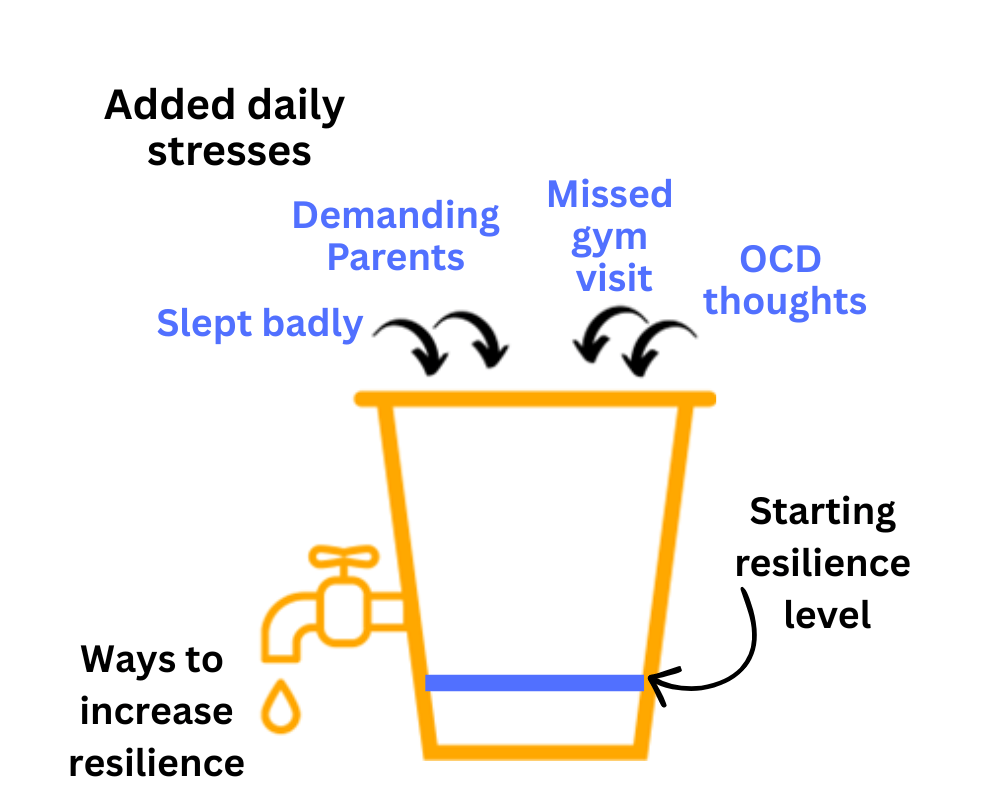
A great analogy for this is: The threat bucket

The water level is your resilience level at the start of the day – and it will depend on how safe your brain feels. 

The arrows going in are your daily additional stresses – some days these will be less and the bucket wont overflow, other days they’ll be coming in so quickly you can’t keep up, if your bucket overflows you’re moving into fight or flight.

Note: if you have OCD it’s likely that your base line water level will already be higher to start with and if you’re ruminating throughout the day it’s a bit like having a hose filling that bucket up with a steady drip, drip, drip. 

Taking this metaphor a bit further we can release some of this built-up stress with the tap at the bottom of the bucket.  This is where all the self-care and routine comes in, those little daily habits which lead up to big results, or in this case resilience. 

Routine can be incredibly important in OCD recovery as it improves our resilience levels allowing us to deal with obsessions (intrusive thoughts) more easily – remember those days when you’re able to dismiss that same thought that kept you caught a pervious day?  Those are the days your resilience is high and you’re not suck in fight or flight.    

Routine including: good nutrition, sleep, movement, social connection and relaxation are unbelievably important for recovery maintenance.  This is why I’m a PT, I’ve had to force myself to live the lifestyle I know does me good.  The brain and body automatically seek comfort but this is not what keeps us healthy, especially when we’re dealing with mental health issues. 

If you know you find the holidays hard then it can be so helpful to prepare some support in advance, where you can try and keep some elements of your routine in place.  Maybe drink a little less, take a walk after dinner, make sure you have a good meal, including protein, before you start on the sugary treats, have someone you can talk to if it gets tough, write down the things you know help and refer back to them if OCD hits. 

I did just this and it really helped me out over the last few days, remember when you’re in fight or flight it’s very hard to think rationally so you want everything in place and ready beforehand.  If you’re not sure where to start then comment ‘FOUNDATIONS’ in the comments below and I’ll send you a link to one of my foundations trackers to get you get started.   

I’m going to follow this post up with a more detailed look at what happens when that bucket overflows, so don’t forget to subscribe.

Remember, you are not alone,
Stay Strong xxx

Understanding Thought-Action Fusion in OCD

Thought-action-fusion is a common cognitive distortion associated with OCD.  It’s where a person believes that having a thought is equivalent to performing an action, or that thinking something makes it more likely to happen.

It is a very important distortion to be aware of if you’re suffering from OCD as when you’re in fight or flight mode – talked about in my previous post – anything can feel possible.     

Remember when we are suffering from OCD we are highly likely to be in the fight or flight (sympathetic) part of our nervous system. When in fight or flight our ability to think rationally goes out of the window and so things that we know to be impossible, when in our rational minds, can feel possible! 

When struggling and ruminating on an OCD obsession the brain and body are suffering with high stress (fight or flight), when in this state our memory becomes selective and fragmentedOur attention narrows (tunnel vision) and our hippocampus (memory organiser) works less efficiently.

The result of this is that we can get gaps in our memory, Out-of-order recall and confusion about timelines. In addition to this the brain searches for danger-related memories, and the Safe or neutral memories are harder to access. 

It’s important to note that a Strong memory ≠ accurate memory.  Stress increases confidence in memory and emotional intensity but decreases, detail accuracy, context and perspective! 

All this results in intrusive memories feeling more real because they’re emotionally tagged

  • “What if” thoughts feel urgent due to amygdala activation
  • Memory distrust develops (“What if I forgot something important?”)

This fuels checking, reassurance, and rumination.

For me this was one of the most enlightening distortions to learn about.  Following my nervous breakdown, I was constantly in my sympathetic nervous system and so I had a few events when an intrusive thought occurred, and I couldn’t remember clearly/rationalise it/work it out, this caused me unbelievable distress. 

Thought-action-fusion can make you feel like a thought is real and because of your mental state your inability to rationalise that distortion feeds the uncertainty.  We need to recognise this pattern when it happens for what it is and reduce the impact by:

  • Not trying to ‘figure it out’ while anxious – this includes during the night, no analysis between 11pm and 5am remember! 
  • Remembering that you’re in fight-or-flight, you’ll be thinking in extremes and this is not evidence.
  • Find ways to reset and come back into the parasympathetic nervous system (rest and digest). 

I really love Byron Katies method for this where we say:
Is it true?
Is it 100% true? 

If the answer to the second question is no – which it will be because the stress is based on doubt and uncertainty, then ‘you have to let it go’.   

Why would you torture yourself over anything less than 100% certainty? 

Fear lives in the vague after all and it’s my guess, it’s just a thought (obsession), attached to a feeling of uncertainty, that you’re basing your rumination on, not facts. 

Your brain is probably desperately trying to work out whether there is something genuine to be concerned about, you should take this as your sign that there isn’t!   

I really hope this helps, OCD recovery isn’t easy and sometimes thought-action-fusion can get worse when we are in recovery and start to let our guard down, but know and trust who you are and as always,

Stay Strong xxx

Why OCD Compulsions Make it Worse!

If you’ve landed here, you probably already know a bit about OCD but in case you don’t here are the Cliff notes.

OCD stands for: Obsessive Compulsive Disorder. 

Obsessions are: unwanted, intrusive, and distressing thoughts, images, urges, or feelings that repeatedly enter a person’s mind and cause significant anxiety. 

The resulting compulsion is a repetitive behaviour or mental act that a person feels driven to perform in response to the obsession. 

Todays blog is all about why the compulsion part of OCD is not helpful for us. 

When you have OCD completing a compulsion, whatever it may be, is done out of a need to neutralise the obsession in some way. 

Examples of compulsions include; driving back round to check that a bump in the road wasn’t a person.  Washing your hands more than once to make sure they’re clean.  Going back to check if the oven is off, or that the doors are all locked and secure. 

There are in fact endless examples, and we’re all slightly different which can make OCD a very tricky beast to catch. 

It can be hard at times not to complete a compulsion, especially if we feel responsible for others safety but I’ve found that by invalidating the supposed ‘safety guarantee’ of the compulsion, the need to do it disappears as well. We start to see it as pointless – because it is, read on to see why.

How do I know if it’s an OCD compulsion?

The real clue to whether it’s an OCD compulsion or not, is that when it’s OCD it’s normally accompanied by distress.  Afterall if we don’t mind the compulsive action, then is it an issue?

People with OCD are normally fighting an inner battle where they are trying to work out the doubt and uncertainty they are feeling – impossible by the way – and compulsions such as checking or ruminating can feel like a productive way to do this.  Well, I’m here today to confirm to you that IT IS NOT. 

We feel like the compulsions are’ ‘helping us’ and ‘keeping us safe’ but they’re doing the complete opposite, yep you heard it right, they are making everything worse!

Now I’m not a qualified therapist but I know from years of experience that as soon as you give into one of those compulsions, you are validating the faulty signal coming from the amygdala and telling the brain that there is something to worry about.  You’re basically saying,

‘hey brain, this is important, you need to be on high alert and focus all your attention on this obsession’.    

By doing this you are putting yourself into your Sympathetic Nervous System, more commonly known as fight or flight.  Once in this state you will not be thinking rationally. The logical brain switches off and passes everything over to the more primal survival part of the brain. This part of the brain is all about keeping you safe and you’ve just told it, by giving into the compulsion, that there’s something it needs to worry about. 

Basically you’ve just started to fall down the rabbit hole.  I told you last time, he might look fluffy but he’s a whole lot of trouble!

When in fight or flight you cannot think rationally and so you are in a state where the brain can convince you black is white, up is down and left is right – things you know to be impossible!  You are not able to reason or be sensible in any way in this state and giving into an OCD compulsion puts you in this state.

How do you know when you’ve reached this state?  It can be hard when you’re in it to know but I like Martha Becks phrase:

‘If you’re struggling, you’re spiralling’

basically if it’s causing you distress then you can be pretty sure you’re in fight or flight. 

At this point you need to step away and reset.  Say ‘thank you brain, that’s exactly what I wanted to hear right now’ and carry on with your day aligning with your values.

More tips on how to do this coming next week, so don’t forget to subscribe below!  

In summary, compulsions are pointless because:   

  • As soon as we complete a compulsion, we validate the faulty signal aka the obsession. 
  • This then takes us into fight or flight – as we we’ve just told the brain there’s something to be worried about
  • Once this happens, we can’t think rationally
  • This cycle is self perpetuating.

I have illustrated it below to make it clear.

Hopefully you can now see why completing compulsions is COMPLETELY POINTLESS!!!!

I really hope this helps, let me know in the comments below.
As always, Stay Strong xxx

The Role of Values in Overcoming OCD

I’ve mentioned values in several posts to date, and I feel it’s time to take a closer at them and why they are so important in OCD recovery. 

What’s a value anyway? 

Lets start at the beginning, a value is: ‘a principle or standard of behaviour; one’s judgement of what is important in life’.

They are the standards we set for ourselves to live by, they outline the things that are most important to us and help guide us with our daily choices. 

If you’ve done any ACT (acceptance commitment thearpy), then you will know that values work is one of the 6 core principles

They describe values as something you, ‘do’ rather than ‘have’. They are verbs not nouns, general directions and guiders for life, a place you can never arrive at but are always striving towards.  

From this description they can feel quite nebulous, but they are the invisible building blocks of our lives. 

How do you work out your values?

There are lots of great exercises online that you can work through.  Here are a couple of links to try but a quick google will find you lots of information on the topic.

Values worksheet 1

Values worksheet 2

If you’ve never done this work before then I advise spending a bit of time working through one of the above activities. 

So why are values so important in OCD recovery? 

They become especially useful when you are struggling because you can align to your values and know that that’s the person you want to be. 

You can then take actions towards your values, regardless of the thoughts and how you feel, which is exactly what we need to do when OCD gets loud.

OCD has a nasty habit of making you think you’re the worst person in the world, capable of distressing and horrible things and when you’re spiralling it can be incredibly hard to pull yourself out.

Your values then become a superpower, acting as your anchor during these difficult times.  They remind you of who you truly want to be and allow you to proactively take action to align with them. 

Say for example that your values are to be an honest, trustworthy, reliable, kind and loving person, then when OCD is telling you otherwise you have the opportunity to say;

‘No OCD, I’m not who you’re telling me I am, I know my values and I’m going to carry on with my day aligning to them’. 

The brain believes what it sees, so if you live your life aligning to your values then you will be banking undisputable evidence of who you are. The OCD thoughts then become much easier to dismiss and don’t take hold as easily. 

In addition to this it’s worth remembering here that OCD thoughts are ego-dystonic, which refers to the fact that the obsessions and compulsions are inconsistent with a person’s values, beliefs, and self-image, understandably causing a lot of distress.  

When going through OCD therapy and recovery it can feel so tough at times and your values can act as your guiding light through the darkness. 

Every time it feels overwhelming and tough, you need to remind yourself of your values and ask yourself;

‘If I’m aligning with my values and the person I want to be then what would I do in this situation?’  

  • Would I drive back and check if that bump in the road was a person or would I carry on with my day?
  • Would I wash my hands again because they still feel dirty or would I just carry on with my day?
  • Would I spend hours ruminating over the nightmare I had last night and not make it into work, or would I just carry on with my day?

There are endless scenarios you could use here but ultimately you have to ask yourself, is your OCD holding you back from the values-based life you want to live? 

I’m guessing the answer is yes.   

The amazing thing about doing values work, is that once they’re in place they allow your life to become more focused and meaningful in all ways.  You become empowered to let anything that doesn’t align with them go, which quite often results in a lot less drama, mental health struggles and a lot more peace.

I’d love to know if you have also found ACT therapy and Values work helpful in your OCD recovery, please share your insights below.

As always,
Stay Strong xxx

Why Habituation is key to OCD Recovery

Last week I posted about choice and why it’s so important in OCD recovery.  Towards the end of that post, I mentioned habituation and I felt the topic so significant for me in my recovery that it deserved it’s own post, so here we are.

What is habituation?

According to google it is:

‘the process of making or becoming accustomed or used to something.’

In Psychology specifically it’s:

‘the diminishing of an innate response to a frequently repeated stimulus.’

When applying this to OCD specifically:

We can see ‘the innate response’ as the compulsion and ‘the repeated stimulus’ as the obsession. 

Applying habituation to OCD recovery

We learn in therapy that everyone gets intrusive thoughts and so the aim in OCD recovery is not to get rid of the thoughts (obsessions) but to see them as completely irrelevant. 

We do this by recognising the trigger (obsession) when it comes in and habituating (getting used) to it, so that we no longer feel the need to complete the compulsion – whether it be mental or physical. 

This was a big turning point for me, realising that the obsession is something you can ‘get used to’.  The result of this is that the brain eventually no longer brings your attention to it – as it starts to see it as insignificant. 

For a long time I saw OCD recovery as not having the obsessions but now I see that it’s my reaction to the obsession that is the key.  I have no control over whether the thought/image/whatever appears or not only my reaction to it.

The Reticular Activating system and habituation

You only have so much mental capacity each day and the brain has an unbelievably effective filtering system called the reticular activating system or RAS for short. 

According to Jim Kwik’s book Limitless,

‘every second your senses gather up to 11 million bits of information from the world around you…
…the conscious mind typically processes only 50 bits per second. ’

‘(The RAS) also acts as the gatekeeper of information through a process called habituation, which allows the brain to ignore meaningless and repetitive stimuli’  

So the brain takes in an unbelievable amount of information every second and then decides what it’s going to bring to your attention and what it’s going to discard, mostly down to what you’re telling it you feel is important!

When you are struggling with OCD and you see the obsessions as important the brain will prioritise these thoughts above all others. Once you start to habituate yourself to the OCD triggers the brain will no longer use its finite resources on information you’re telling it is irrelevant.  It will file it as a ‘meaningless and repetitive stimuli’ and no longer bring it to your attention.

Yes, this is habituation and it’s where OCD recovery happens!   

A note here to highlight that we shouldn’t expect our obsessions never to show up again.  Every now and then the brain will throw one to the forefront of your mind and say,  ‘Remember this?  You were really obsessed with this at one point, is it still important?’ and your only job is to do absolutely nothing.  This is how we break free from OCD. 

In summary, we need to habituate to our obsessions, show the brain that they’re insignificant and carry on with our day aligning with our values. This is how we live our lives in recovery. 

Not sure on your values? Then be sure to subscribe below as that’s what next weeks post is going to be all about.

As always,
Stay Strong xxx 

Overcoming OCD: The Power of Choice

I have recently had the pleasure of coming across the choice article written by Dr Steven Phillipson – a licensed clinical psychologist who specialises in Cognitive-Behavioural Therapy for OCD.  It’s such an extraordinary piece of work and a must read for anyone suffering from OCD.  It is quite lengthy but there is an audio version here.

The focus of the article is how we need to see OCD thoughts as irrelevant and that we DO have a choice when it comes to this decision.

I know only too well when you have OCD you can feel like you have no choice but to do the compulsion when the thoughts come in, the doubt & uncertainty that comes with not knowing 100% whether the thought is significant can feel too much to bear. 

However, we need to start to see this part of the brain as an independent system from our conscious thoughts, one that works automatically – like the systems which control automatic functioning in the body such as breathing and heartrate.  We do this by becoming aware of our automatic thoughts and autopilot, making the choice to carry on with our day, align with our values and see the thoughts as meaningless and irrelevant – because they are.  

Below is a quote from the article which I thought was helpful:    

‘what do our feelings say about our fundamental beliefs? I believe that the answer to this question is, “Not necessarily very much.” Our feelings are not a reliable measure of our self-perception. Why? Because automatic thoughts can create feelings that are just as convincing as thoughts that reflect our deeply held beliefs. So, it is vital that we do not reflexively take the thoughts and feelings that our brains send to us at face value.’

Here Dr Steven Phillipson is highlighting the fact that automatic thoughts can create feelings, these feelings can make things feel more real.  Therefore, we shouldn’t put too much emphasis on how we feel as feeling are NOT within our control. 

Why would we give up our autonomy (our right to make informed decisions about our lives) to something we have NO control over? (Remember, we cannot control our thoughts and feelings only our behaviours. )

Another great quote from the article:

‘Remember when you have OCD, you cannot use your feelings to determine if a threat is ”real”.  Doing so is a little like asking the Devil for directions to heaven’.

I always remember this quote when I’m starting to spiral as it happily reminds me that I cannot trust those feelings.

The article highlights how when one has OCD the amygdala – whose primary function is to process emotions, especially fear and anxiety – is sending us a faulty signal that there is something which needs our attention right away and cannot wait. Our job – through ERP therapy – is to become habituated (the process of making or becoming accustomed or used to something.) to this alert. 

This is no easy task and can feel very uncomfortable. Choosing to ignore your brains warning system and take the chance that it’s a false alert can truly feel like jumping out of an aeroplane not knowing whether your parachute is packed correctly. However this is the chance we have to take to show the brain that the signal was faulty, we literally do nothing about the thought and carry on with our day aligning with our values.

More on habituation coming in future posts but for now I’m going to leave you with this motivational mantra which I use all the time,

Every day is a new opportunity for me to show my brain that this continued prompt is meaning and irrelevant. 

I really hope it helps you too:
As always, stay strong xxx

OCD – Maybe This Time it’s Real!

Ever heard yourself thinking this?  Maybe you’ve had OCD for a while, maybe you’ve had some therapy and you know all the tools; don’t engage with the thoughts, go on with your day like the thoughts are irrelevant, don’t fall down the rabbit hole – sounds familiar?    

You know it all but then comes that little voice which saying, ‘but what if this time, it IS important, it feels so real.’      

Don’t be fooled, it’s OCD’s sneaky trick, ramping up the doubt and uncertainty to take hold of the one thing it wants, your complete attention.

When you get triggered – for whatever reason – it can feel desperate, like this thought (obsession) needs all your time and energy – if you could just work it out this time then you would be OK. 

Well let me tell you it’s not important, your mind is telling you lies and trying to capture your attention.  Your scared amygdala (the part of the brain responsible for triggering the body’s fight-or-flight response to threats) is sending you a faulty signal and your only job is to not engage. 

The only way the brain can truly learn that the signal is faulty is by not engaging with the thought (obsession) and seeing for itself .  Any attempt to try and neutralise the thought will tell the brain that the signal was important & so perpetuate the OCD cycle.

OCD Cycle

Remember,

‘If you’re struggling, you’re spiralling’. 

If it feels desperate/urgent you can be sure you’re not thinking rationally, you’ve switched over to fight or flight mode and you will not benefit from completing any compulsions (repetitive physical or mental behaviour a person feels driven to perform to alleviate the anxiety, distress, or unease caused by an obsession).    

So ‘how?’, I hear you shout, when it feels so important, do I ignore my brains natural instincts and just carry on? 

It’s tough, it can feel like stepping out of an aeroplane not knowing if your parachute is packed correctly. Sometimes it can feel like the risk isn’t worth it, especially when people you love are involved,

examples include:

‘I must make sure my hands are extra clean before making my children’s tea, I should wash them a second time.’

‘I need to go back and check I didn’t hit anyone when I felt that bump on the road.’

‘I have to hide all the knives in case I loose control and hurt someone.’

Your brain tells you can’t take the risk and you’re just being a responsible person by making sure.

It’s worth pointing out here that we shouldn’t give our feelings so much credit either, we cannot control them, so don’t let them control you!  Feelings are not facts!

However know that by not sitting with the thoughts you will be drawn into them. 

You might think you’re being responsible but what the people around you see – the ones you love and are trying to protect – is a person who isn’t fully engaged in the world, has become irritable, withdrawn, detached, distressed, less empathetic and is really struggling.  

When we dissolve into our thoughts, our subconscious takes over our outer functioning – this is the you the world sees! Because you are so caught up in your thoughts your brain goes into default mode and it uses programs it picked up from when you were a child! Is this what you want? 

Wouldn’t you rather be showing up in your life?  Aligning to your values, trusting yourself and getting on with the things you enjoy, with the people you love? 

Does that make sitting with the thoughts a risk worth taking? Know your reason and keep it at the forefront of your mind whenever those thoughts come knocking, it will give you the strength and resilience to push though.  

Don’t let OCD steal anymore of your life, the time you have with the people most important to you and the dreams and ambitions you have for yourself.   

It might feel real this time, but my guess is if you leave it be, it will float away and be replaced by another thought pretty quickly and I bet you that one will feel just as real! 

Take a step back and just have a laugh at the madness that is OCD, I know it doesn’t always feel like you want to laugh when you have OCD but it’s a way of detaching yourself from the lies it tells you. 

I hope it helps, you have totally go this.
As always, Stay Strong xxx

Don’t miss another post, subscribe today.

OCD – The thoughts are Irrelevant

Lady with thoughts above her head.

Paradoxically the word irrelevant has become extremely relevant in my life recently.  

It is exactly what we have to see OCD obsessions (unwanted, intrusive, and distressing thoughts, images, or urges that repeatedly enter a person’s mind, causing anxiety or distress) as. 

It sounds so easy but when your brain is telling you there is danger right here, right now and it’s letting off all the warnings signals, it can feel like you’re going against every natural instinct you have, not to do the compulsion (repetitive physical or mental behaviour a person feels driven to perform to alleviate the anxiety, distress, or unease caused by an obsession) and find that momentary relief.    

This is why it feels so hard, the brain – for whatever reason – has let off it’s fight or flight response.  The job of this system is to make you remove yourself from danger/discomfort. To act in opposition to this response is to go against your natural instincts. 

OCD is a fault in this system, the brain is alerting you to danger where there is none and it can only learn this when you sit with the uncomfortable feeling and go about your day as if the thought is completely irrelevant. 

No matter how you feel, you must carry on with your day and allow the brain to learn that the signal is a false alarm.  In contrast by giving into the compulsion you never give your brain a chance to see that there was nothing to worry about in the first place. 

The focus should be on living a valued based life and not trusting your feelings to guide you. Feelings are out of our control and so allowing them to dictate your actions is foolish. 

Decide on your values and live each day in accordance with them regardless of how you feel.  This way the brain learns it doesn’t need to complete a compulsion for every random obsession that pops into your head. 

This is also how the brain starts to heal and your scared amygdala (the part of the brain responsible for triggering your fight or flight response) which keeps letting off these false alerts, learns that it doesn’t need to be so scared anymore.  This does take time and I’m still in this process myself but having the knowledge that the current signals are faulty, and your brain is just a bit scared is so empowering. 

It can be very frustrating at times when you have OCD and easy to beat yourself up about it but Martha Beck tells us to imagine our amygdala as a scared animal. Would you say cruel things to a scared puppy, or would you show it kindness and love?  We all need to be a bit kinder to ourselves and realise that OCD is just our brain being scared incorrectly. 

See each day as an opportunity to get stronger and show the brain that these faulty signals are meaningless and irrelevant!

I know this work is hard, but you are not alone, you are not a bad person, and you are braver than you know. 

As always,
Stay Strong xxx

Don’t miss another post, subscribe today.