
I have had OCD for what is fast coming up to 30 years. As I quickly approach my 41st birthday it can sometimes feel like I’ve been fighting a war inside my brain for what feels like forever. I’ve read all the books, listened to the podcasts, had a couple of rounds of therapy, trained as a yoga teacher and PT, I look after my nutritional and physical health, and choose to share what I’ve learnt in the hope of helping others through my blog, Instagram posts and workshops.
So why I ask myself do I still struggle at times? Why does the world still feel overwhelming & why won’t my nervous system just relax already?
Maybe my expectations are too high? I had a therapist once say to me that I might just have to ‘accept the fact that I’m an anxious person’, not really what you want to hear but then expecting to find total inner peace is probably a little unrealistic too I realise.
I know Steven Phillipson says, ‘I don’t care how you feel, continue with your day aligning to your values’ and I try to do this. It is in fact how I’ve managed to achieve everything I have over the last 10 years but I do sometimes wonder how much noise is normal?
I wrote in a post a while back: ‘When we have OCD, Fight-or-flight can turn into a trait instead of a temporary state!’ and this is how I feel, like I’m stuck in fight or flight most of the time. My ability to relax, be in the moment and not feel overwhelmed is seriously lacking.
I feel like I’ve been on a mission the last few years for answers – which I now realise may be a sneaky compulsion of mine, eek! Maybe what I should have been doing is letting go of the rope – another ACT metaphor which I love.
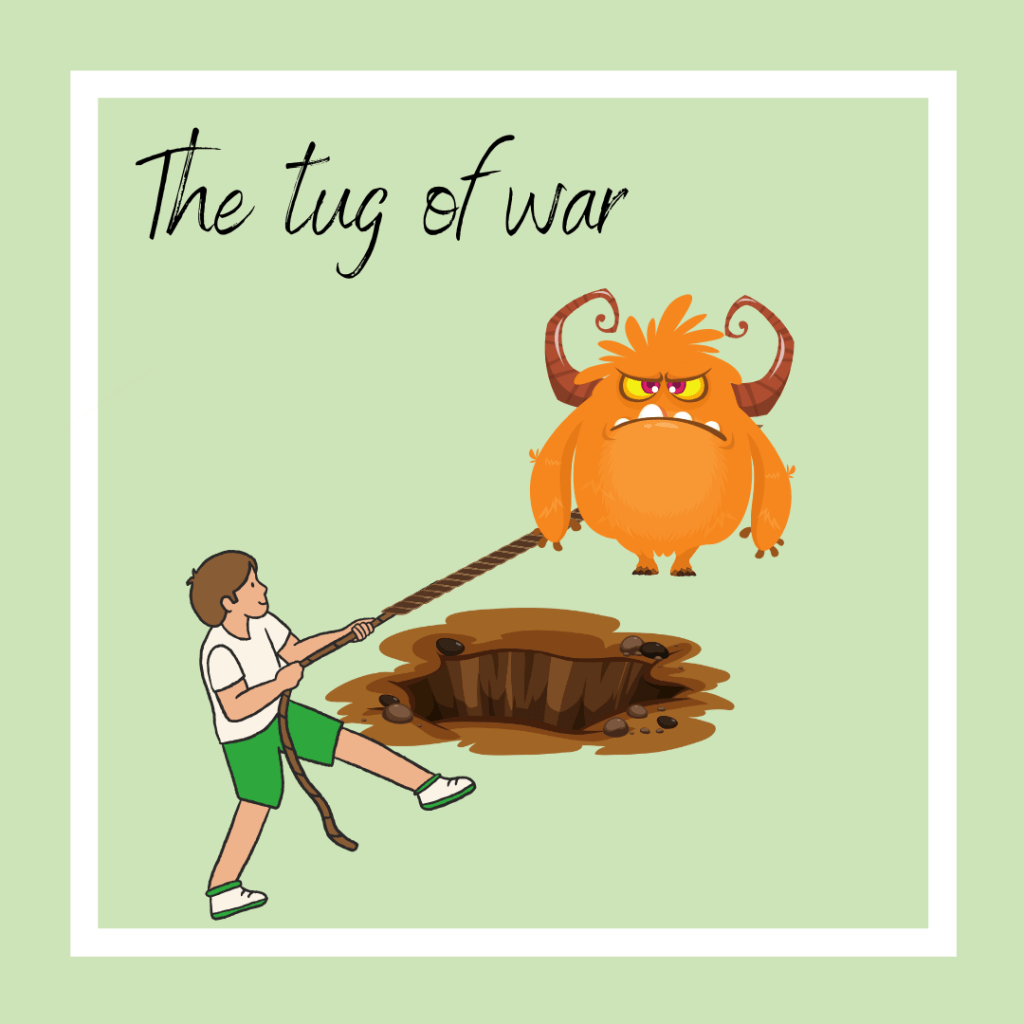
This ACT metaphor illustrates how struggling against your obsessions (the monster) is a never-ending fight, but Letting go of the rope and not engaging with your intrusive thoughts, accepting the presence of them and carrying on with your life while aligning to you values is your way to freedom.
Breaking it down a bit further:
- The Monster: Represents your OCD obsessions.
- The Rope: Represents your attempts to control, avoid, or eliminate these obsessions with compulsions.
- The Pit: Represents the fear of being consumed by, or drowning in your obsessions.
- Letting Go: Means dropping the rope (not completing the compulsions) and ceasing the battle, not necessarily defeating the monster (obsession).
We need to recognise that fighting our obsessions is exhausting and ultimately ineffective, allowing our difficult thoughts and feelings to be present without fighting them is the key, this then frees up energy and attention to focus on what actually matters.
I wonder then have I secretly been pulling on that rope and keeping my OCD alive with all my research and development? Argh! Does it all actually come down to my inability to just stop and sit with the feelings?
As I head towards my 30 year anniversary with OCD, I need to acknowledge that some education with OCD is important but then try to recognise where the line is between being informed and it being a compulsion.
Have you got any sneaky defaults which are keeping your OCD alive and kicking? Do you feel like you’re doing everything right but you’re still struggling too?
Maybe try and keep a list this week, whenever you notice yourself doing something unnecessary because of your OCD, write it down, awareness is the first step to being able to change these traits, which we have unknowingly accepted into our lives.
On a more positive note and bringing some hope back into the conversation. I do have the odd occasion when I come out of fight or flight and it feels so wonderful. It feels like what life should be, I’m present, in the moment and experiencing life as it could be, full of opportunity and joy.
If I have one target for the next 40 years it’s to spend as much time as possible out of fight or flight and if I can achieve this I will be a very happy soul. I want to be able to enjoy life without rushing through it, listen when people talk, take joy in the small things and the process of getting to them.
Let me know if any of this resonates with you. It can be very lonely at times to have OCD, and community can help us feel that less.
A bit of a heartfelt one this week as I approach that 30 year milestone but sometimes that’s what’s needed.
As always, you are not alone,
Stay Strong xxx






 Conquering OCD