Why OCD Compulsions Make it Worse!

If you’ve landed here, you probably already know a bit about OCD but in case you don’t here are the Cliff notes.

OCD stands for: Obsessive Compulsive Disorder. 

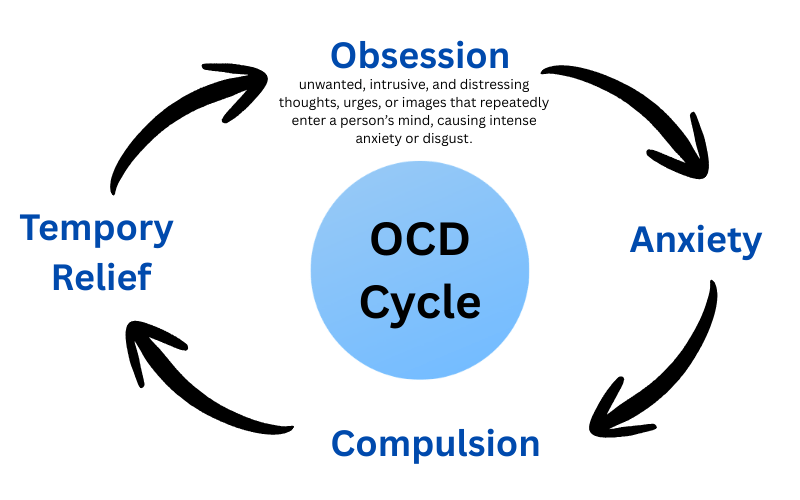
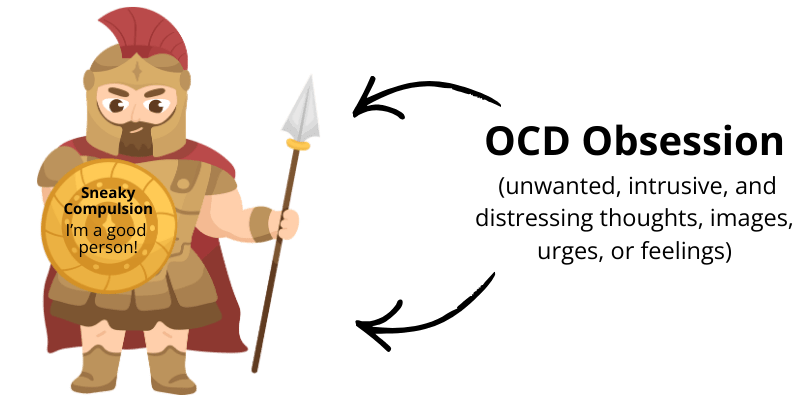
Obsessions are: unwanted, intrusive, and distressing thoughts, images, urges, or feelings that repeatedly enter a person’s mind and cause significant anxiety. 

The resulting compulsion is a repetitive behaviour or mental act that a person feels driven to perform in response to the obsession. 

Todays blog is all about why the compulsion part of OCD is not helpful for us. 

When you have OCD completing a compulsion, whatever it may be, is done out of a need to neutralise the obsession in some way. 

Examples of compulsions include; driving back round to check that a bump in the road wasn’t a person.  Washing your hands more than once to make sure they’re clean.  Going back to check if the oven is off, or that the doors are all locked and secure. 

There are in fact endless examples, and we’re all slightly different which can make OCD a very tricky beast to catch. 

It can be hard at times not to complete a compulsion, especially if we feel responsible for others safety but I’ve found that by invalidating the supposed ‘safety guarantee’ of the compulsion, the need to do it disappears as well. We start to see it as pointless – because it is, read on to see why.

How do I know if it’s an OCD compulsion?

The real clue to whether it’s an OCD compulsion or not, is that when it’s OCD it’s normally accompanied by distress.  Afterall if we don’t mind the compulsive action, then is it an issue?

People with OCD are normally fighting an inner battle where they are trying to work out the doubt and uncertainty they are feeling – impossible by the way – and compulsions such as checking or ruminating can feel like a productive way to do this.  Well, I’m here today to confirm to you that IT IS NOT. 

We feel like the compulsions are’ ‘helping us’ and ‘keeping us safe’ but they’re doing the complete opposite, yep you heard it right, they are making everything worse!

Now I’m not a qualified therapist but I know from years of experience that as soon as you give into one of those compulsions, you are validating the faulty signal coming from the amygdala and telling the brain that there is something to worry about.  You’re basically saying,

‘hey brain, this is important, you need to be on high alert and focus all your attention on this obsession’.    

By doing this you are putting yourself into your Sympathetic Nervous System, more commonly known as fight or flight.  Once in this state you will not be thinking rationally. The logical brain switches off and passes everything over to the more primal survival part of the brain. This part of the brain is all about keeping you safe and you’ve just told it, by giving into the compulsion, that there’s something it needs to worry about. 

Basically you’ve just started to fall down the rabbit hole.  I told you last time, he might look fluffy but he’s a whole lot of trouble!

When in fight or flight you cannot think rationally and so you are in a state where the brain can convince you black is white, up is down and left is right – things you know to be impossible!  You are not able to reason or be sensible in any way in this state and giving into an OCD compulsion puts you in this state.

How do you know when you’ve reached this state?  It can be hard when you’re in it to know but I like Martha Becks phrase:

‘If you’re struggling, you’re spiralling’

basically if it’s causing you distress then you can be pretty sure you’re in fight or flight. 

At this point you need to step away and reset.  Say ‘thank you brain, that’s exactly what I wanted to hear right now’ and carry on with your day aligning with your values.

More tips on how to do this coming next week, so don’t forget to subscribe below!  

In summary, compulsions are pointless because:   

  • As soon as we complete a compulsion, we validate the faulty signal aka the obsession. 
  • This then takes us into fight or flight – as we we’ve just told the brain there’s something to be worried about
  • Once this happens, we can’t think rationally
  • This cycle is self perpetuating.

I have illustrated it below to make it clear.

Hopefully you can now see why completing compulsions is COMPLETELY POINTLESS!!!!

I really hope this helps, let me know in the comments below.
As always, Stay Strong xxx

5 Simple Words to Help Manage Intrusive Thoughts Effectively

‘I’m not answering that question’, 5 simple words and yet it can feel so hard in the moment. 

When you’re spiralling – for whatever reason – you can feel quite desperate and like you must focus all your attention on answering OCD/anxieties questions, because ‘this time it might matter’, ‘I can’t take that risk’ or ‘I need to check, just in case’!

Does all this sound familiar? 

I get this a lot, in fact most days.  Sometimes something will happen or sometimes it can literally be an uncomfortable thought, feeling or emotion and that’s it my brain will hyper-focus on trying to work out the answer/solution as if it’s life or death! 

Sitting with the doubt can feel like too much, when it’s the people you love, your own mortality or something that strongly conflicts with your values.  You feel like the risk is too high and you must know the answer right now! 

Well let me tell you something, this is OCD and anxieties favourite game.  It wants to steal your focus, it wants your time and energy and nothing but your full attention is acceptable.  It likes to throw things at you until something sticks and then, aha, it’s got you, say goodbye to the rest of your day! 

So, how can we know if it’s OCD and anxiety or whether we genuinely need to pay attention to a thought, I hear you ask?

Ultimately the game is to learn to sit with the uncertainty but I’ve found a good guidepost is to ask yourself the following two questions:

  1. Am I suffering? 
  2. Do I feel desperate and like I need the answer right now?

If you’ve answered yes to either of these questions, then in my experience you can pretty much guarantee that you are in an anxiety/OCD spiral and that you wont be thinking logically/rationally. 

Your job is therefore to do NOTHING!

Step away from the thought and carry on with your day as if it’s completely irrelevant.  You can expect to feel anxious but that’s OK. 

Every time that thought comes back into your head just say the 5 words:

‘I’m not answering that question.’

and carry on with whatever you’re doing.

I do understand that in the moment when your brain is telling you that thought needs all your attention it can feel impossible, but you need to be brave and let it be. 

Another time this is particularly helpful is at night, when our rational brain is having a rest and we’re never thinking at our best. Things ALWAYS seem worse in the middle of the night so just tell your brain, I’m not answering that question’.

I really hope it helps you as much as it has me,
Let me know how you get on and as always,
Stay Strong xxx

OCD – How to know if you should pay attention & why we don’t trust ourselves.

I wrote last week about trust being maybe the most important thing in OCD and Anxiety recovery.  I’ve been using this concept over the last week in my OCD work and there really does seem to be something in it. 

Ultimately OCD thrives on doubt, and that doubt is in yourself and your ability to cope with whatever situation life/your brain throws at you.  It’s our inability to trust that when placed in a situation, we’ll take the right action/make the right decision/act in accordance with our values/be able to cope with the whatever’s thrown our way.

So why don’t we trust ourselves?  Who or what has made us doubt our own mind & judgement?

We’re generally told not to go looking for reasons we have OCD in therapy and the current belief – or so I understand – is that it is potentially a mix of genetics & life experiences but as far as I know there are no certainties here.    

Ultimately, we don’t need to know why we have it to recover from it, but it is my belief that OCD is often triggered when we’re in periods of heightened emotional stress.   Potentially trauma but also new mums, big life changes, times when our parasympathetic nervous system – fight or flight – is more active for whatever reason. 

When in this mindset (fight or flight) we think less rationally (trust ourselves less), our emotional brain is more active and so the thoughts that come up could potentially be stickier/more triggering to us. 

I know when my OCD/anxiety has been triggered, for whatever reason, I am then more vulnerable to other OCD thoughts/triggers – a reason ERP can be so hard.  When I’m back in my sympathetic nervous system – rest and digest – often I can dismiss THE SAME THOUGHTS easily (I trust myself). 

Another example of this is at night when the rational side of the brain (prefrontal cortex) winds down for a rest and the emotional side of the brain takes control.  Ever thought something in the middle of the night and freaked yourself out, not been able to get back to sleep and then in the morning thought, what the…….???? Yep, that’s what OCD feels like.  The logical part of the brain seems to switch off and you’re in fight or flight, thinking in black and white, able to convince yourself that up is down and potentially you could secretly be a psychopath/murderer/paedophile/whatever your current theme may be. 

This emotional part of the brain is powerful – imagine it like an elephant and the logical thinking part like the rider.  The rider cannot control the elephant; it must work with it otherwise it will take control.

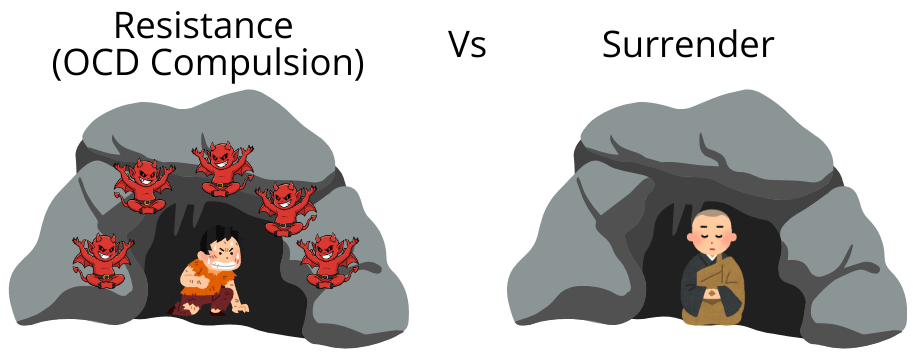
We regain our trust and switch the logical brain back on by sitting with the thoughts and doing, well, nothing.  This, when you’re in fight or flight is terrifying, almost impossible at times.  Your brain is desperate to work it out, it feels like it needs to know NOW!  But that need and desperation is your sign that you are spiralling, and you actually need to do nothing

I read Martha Becks new book, Beyond Anxiety, recently – some great bits in there for anyone who like to read – and she used the phrase,

 ‘If you’re struggling, then you’re spiralling’

which I really liked, because it’s not always easy to detect whether it’s your OCD/anxiety calling the shots or whether it’s actually something you should be paying attention to. In fact your brain will be telling you it’s the only thing you should be focusing right now. But if you’re suffering/struggling/distressed you can trust that you’re not being rational, and it IS your anxious OCD brain catastrophising. 

Once the logical brain switches back on, you’ll easily be able to rationalise the thoughts – I promise. 

I also know that when OCD is bad, the amount of time you spend out of fight or flight is low.  I can remember when I had my nervous breakdown, I thought my brain was never going to go quiet – ever.  And then one day I noticed I had a few seconds when it was and I thought, YES, it is possible, but it takes time, I’m not going to lie, it’s tough.  So know that if your OCD is currently bad, you may not be thinking rationally much of the time!   

You might not think this right now, so I’m going to tell you. You are a good person, you are worth it, and there is light at the end of that tunnel, so never give up. 

Stay strong – you are not alone xxx

Does giving into just ONE OCD compulsion matter?

Mental health is like a garden; I love this analogy. 
I have found over the years that I go through peaks and troughs with my mental health, and it is quite often the case that a trough will occur when I’ve become a bit lazy with my ‘gardening’ so to speak.

The ‘weeds’ don’t pop up all at once of course, it’s quite insidious in that respect, but over time they sneak in.  Maybe you let one compulsion go or you avoid a situation which might be a bit uncomfortable – because after all one little slip can’t hurt right?    

Well here’s the bad news, it can!

Know the brain believes what it sees, it notes down what you do and it’s watching ALL THE TIME!  One missed exposure is not just one missed exposure, it’s evidence to your brain that you can’t cope with the situation at hand and so you should do the compulsion, avoid the situation if possible and in the future too – just in case.  You can see how this can lead to a spiral effect and how those weeds can take hold. 

It can very quickly become a slippery slope and before you know it, you’re snowballing, your obsessions (intrusive thoughts) worsen, the brains monitoring systems ramps up, along with your anxiety.  You feel more on edge & you start to loose trust in your own judgement.

‘Last time we did the compulsion and it worked out OK, best do the compulsion again – just in case’.

But if you never give the brain the opportunity to see that you can cope, then how will it ever know?   

It’s tough living with OCD and anxiety.  Every day can feel overwhelming and it’s hard to be constantly putting yourself out there and sitting with uncomfortable feelings, which let’s be honest are designed by nature to try and stop you doing the uncomfortable thing!  We are literally going against our built in mechanisms to stop us doing the scary thing and so it is hard and it’s tiring but it is worth it. 

When you get to drive to the shops without worrying about having hit someone on the way, when you can leave the house without having to check the doors multiple times, when you can use public toilets without fear of contamination, when you can hug your child and not worry about doing something inappropriate, when you can cook the tea without fretting you’ll lose control and stab someone, the list is endless.
Maybe some of these resonate with you or maybe you have some other, obsessions (intrusive thoughts), anxieties or fears that hound you daily.  Whatever they are, know they are not bigger than you, you can overcome the ‘weeds’ and thrive, but you must live the ERP (Exposure, response, prevention) lifestyle. 

It sounds so easy right, ‘just sit with the feelings’, I get it, it’s hard, it’s overwhelming at times, but it is worth it.  When you get a moment and your mind is quiet – yes it can happen – when your body feels more relaxed because it’s not in fight or flight all the time, when you can connect with friends and family because you’re not distracted and irritable, it’s worth it.  It’s freedom, it’s the best feeling.

So, how do we keep the weeds at bay?
Well some of it comes down to keeping what I like to call ‘The 5 foundations’ in check

Ask yourself now, do I…

  • …Sleep enough?
  • …Eat well? 
  • …Move my body everyday? 
  • …Have good relationships?
  • …Allow myself to relax?     

All of the above will help build your resilience up so that when you come to your exposures you are in the greatest mental space to deal with them.  We need to give ourselves the best chance to sit with the feelings that come up and the 5 foundations will do this for you – know that when they slip you will be more vulnerable to OCD thoughts and ERP (exposure response prevention) will be more difficult.

Making ERP a lifestyle, is important. We should be pushing outside of our comfort zones, just a little bit, each day proving to our brains that we are strong, resilient and that the thoughts are irrelevant.

Know that you are not alone, recovery is slow but not impossible and definitely worth it.
As always,
Stay Strong xxx