
Perhaps you’ve had OCD for a while or maybe you’ve recently been diagnosed and you’re looking for helpful information, either way I feel like the following can be useful going into OCD recovery and isn’t always highlighted by therapists.
If you receive therapy through the standard route then you’ll be advised to undertake a course of CBT therapy in the form of ERP (Exposure response prevention), which is the current gold standard for OCD treatment.
Here you’ll be introduced to the OCD cycle
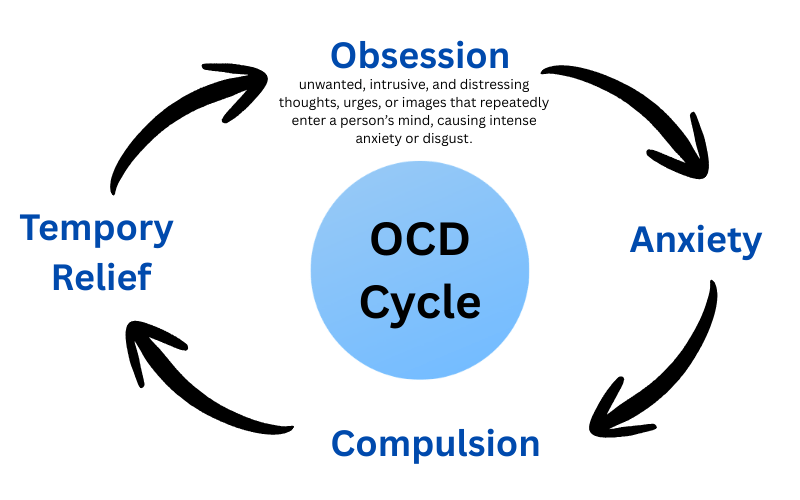
And then told the way to break this cycle is to create a hierarchy of your OCD obsessions and then slowly and in a controlled way, exposure yourself to these obsessions and sit with the associated anxiety, rather than complete your compulsion.
This is indeed a very successful treatment for OCD and sounds wonderfully simple, fantastic you think, I can do this, my OCD will be gone in a matter of weeks and yes this could well be true.
You’ll hear about how you must ‘sit with the anxiety’ and ‘ride the wave’, because any amount of paying attention to the obsession or taking part in the compulsion will just feed the cycle and make it worse, again all true.
You sit in the safety of your therapist’s office and think, ‘yes I can do this, it all makes sense’ and it does, I’m not debating the logic and success of ERP therapy, it really is the best way to get rid of OCD. But what, in my opinion, they don’t pay enough attention to, is how unbelievably hard it is to sit with anxiety, particularly at the start.
Now I’m not trying to scare you or make you feel any worse than you probably already do but it’s important to understand the reality of ‘sitting with anxiety’ as it is, I believe, a life changing skill you have to learn.
When you’re in your therapist’s office, away from your triggers, having a nice chat about anxiety and the OCD cycle, this is a whole different ball game to being out there in the real world and so you need to set yourself up for success.
Picture this, you leave your therapists office full of optimism and hope for your OCD recovery. You get home and get yourself organised, you feel positive, confident and hopeful and then have a go at your first exposure, the anxiety sets in, you feel overwhelmed, all logic goes out the window and you complete the compulsion, after all, ‘just this once wont matter, I’ll sit with it next time’.
So why does it feel so manageable and make so much sense in the therapist’s office but then when you come to do, ‘the work’ it feels impossible?
Well, when you get triggered by your obsessions, you are thrown into your sympathetic nervous system, (fight or flight), this system is there to keep you safe and alive from potential threats and for whatever reason your brain sees your OCD obsession as a threatening situation – OCD is actually a ‘fault’ in this system.
When in fight or flight your brain is designed to get you out and away from these situations asap and so ‘just sitting with it’ although good in theory, can feel unbelievably impossible.
This system is powerful and it overrides your thinking brain, you lose the ability to access logic, perspective taking, rational thinking and working memory among other things – I’ve talked more about this in a pervious post if you’d like more information here.
Suddenly what made perfect sense in your therapists office, seems impossible to even access, let alone execute successfully. Your brain is literally telling you to get out of this situation as quick as possible, do the compulsion, whatever it takes to relieve the anxiety and distress.
Now I’m not telling you that you don’t have to find a way to sit with this survival mechanism, which by the way has kept the human species alive for thousands of years, it just means you need to have the knowledge and tools in place beforehand, so you’re prepared. All this will help you to sit with that feeling when it comes and not complete the compulsion.
Know that your brain will think you’re in a life or death, all or nothing situation and that that is normal!
It will feel like you’re about to jump out of a plane not knowing if your parachute is packed correctly. This might sound extreme, but this is what your brain thinks the OCD obsession means and it will do everything it can to keep you safe.
Knowing this has helped me on numerous occasions to keep moving forward, take that next step and sit with it, it has given me the grit to move past OCD obsessions which in the moment have felt too much to handle.
So how do you prepare yourself?
You need to have this information accessible for when you are triggered, it will confirm that how you’re feeling is normal, as when you’re in a dysregulated state of mind you won’t be able to remember.
I can’t count how many times this has helped me sit with the anxiety and not complete the compulsion.
Ah but does this become a compulsion in itself? I hear you ask…
…I don’t believe so, as eventually, it WILL build a new pathway in the brain and you WON’T need the notes, you’ll notice you’re in fight or flight and you’ll have the knowledge and experience that this is normal and it will pass, I’m not in a life-or-death situation, it’s just my OCD.
But you only get to this stage by sitting through it at least a few times and proving that to yourself. Remember the brain learns from experience and expectancy violation (a core mechanism in Exposure and Response Prevention (ERP) therapy, where a patient’s feared outcome is disproven by facing the fear without doing the compulsion. By violating this expectation, the patient learns that their fear is manageable, and their obsessive beliefs are false, which promotes long-term recovery. ) is unbelievably powerful in all aspects of our lives, not just OCD recovery.
So use the notes to disprove the need for the compulsion and once your brain has enough evidence to know the compulsion is useless, you won’t need the notes anymore.
I know it can feel impossible; it’s supposed to and that’s completely normal. Know that when your therapist says, ‘just sit with it’, what they’re actually saying is:
‘your brain is going to tell you that the world is going to end and you have to do nothing about it’.
The good news is that once you’ve sat through it a few times you start to see that the obsession didn’t happen and it was just OCD. This is the moment you start to take your life back and boy what a feeling that is.
Remember your brain is just trying to keep you safe from what it thinks is a life-or-death situation and it is going to do everything it can to stop you. You have to say:
‘thank you brain, I see that I’m having an OCD thought, I’m going to let it be and carry on with my day, aligning to my values’.
Quite a tough one today but having confirmation of how hard it can be and what you’re up against is important for recovery.
I really hope it helps you as much as it has me,
As always, Stay Strong xxx
 Conquering OCD