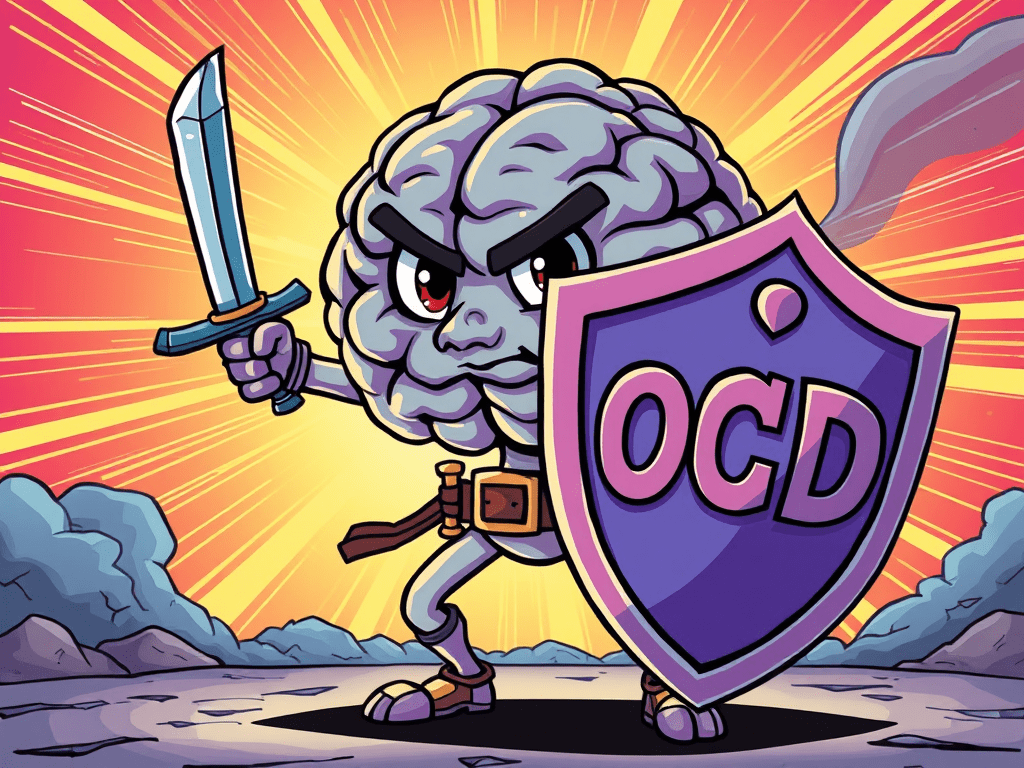
I’ve talked in a previous post about how OCD is closely linked to our sympathetic nervous system, how when we get triggered by an obsession, if we pay attention to it, we get thrown into fight or flight – which is not where we want to be.
This system has it’s uses and, in the past would have been responsible for keeping us alive and safe but when we have OCD, this mechanism – which is designed to be a temporary state – can become a permanent trait!
I guess this is because the brain has seen that by keeping us stuck in an OCD loop we are ‘safe’ from the ‘perceived threat’ and even though we can logically see it’s not a useful mechanism, all the brain can see – who’s main job it is to keep us safe – is that we are still alive, so job done.
It’s worth noting here that the brains top priority is keeping us alive. Not happy, not living our best life, not being socially connected or prosperous, nope, just being alive and if it thinks there are risks and threats out there that need to be avoided – due to OCD’s faulty system – and it thinks the OCD spiral keeps you safe, then it is going to have you looping down that rabbit hole forever!
It does seem that in OCD there is a ‘fault’ in the switch that allows us to dismiss obsessions when they come in, the threat system, seems ‘hot-wired’ but why?
I personally believe (and current evidence seems to confirm) that the ‘fault’ comes from some sort of highly driven sympathetic time or event in a person’s life. This person will most likely have a predisposition (genetic vulnerability) towards OCD; however I also believe that we don’t have to know what that time or event was, sometimes it’s obvious – birth of a child, prolonged periods of feeling unsafe or stressed but other times it’s not and that’s OK.
Putting these two ideas together:
1. That OCD is a fault in the threat detection system
2. The brains top priority is to keep us safe,
we can see how OCD can be seen by the brain as ‘a useful tool’. It becomes a learned habit – ‘if I spend my time focused on OCD thoughts, then I’m safe’.
Is OCD therefore a defence mechanism – albeit a faulty and unhealthy one – to ‘avoid life and keep us safe’?
It feels like quite a big question and something that people with OCD might object to but just stop and think for a second.
Does your OCD stop you from living the life you’d love to live? And in doing so does your brain – rightly or wrongly so – believe that it is keeping you safe?
Another interesting insight I had was that with OCD we tend to know that the obsession is unfounded, and logically not true but because we can’t be 100% sure we get stuck.
Is this another, particularly clever, part of the mechanism? We sit at home ruminating and so not venturing out into the ‘scary world’ with the ‘unpredictable uncertainty’ – but it’s never enough to ever fully convince us that the obsession is true. Therefore, we stay at home, where we are stuck but according to the brain safe, job done.
It’s an uncomfortable theory right: is OCD a defence mechanism the brain uses to keep us safe?
If we look at OCD this way, then we can start to see it for what it is – a badly calibrated, unhealthy and faulty protection system which for whatever reason can feel productive and useful – it’s not.
We need to start to write a new story, remember the brain will always focus on the negative and try and find evidence to prove itself justified.
I would bet for all the negative evidence it finds there’s just as much, if not more positive evidence to the contrary, your brain is just not seeing it – tunnel vision. You need to widen the spotlight and make it a flood light. This way you can see the whole picture and realise everything OCD has been telling you is a very convincing LIE!
This idea of OCD as a faulty safety mechanism has helped me to see that my brain is just trying to keep me safe, it has allowed me to be a lot kinder to myself and even laugh at the non-sensical nature of it.
I hope it helps you too,
As always stay strong xxx
 Conquering OCD